LLM Fine-Tuning vs RAG for Domain Knowledge Injection
Start with RAG for facts, then fine-tune only for proven behavior gaps.

- Written by
- Marta Wierzbicka
- Published
- November 28, 2026
- Reading time
- 9 min read
- Sources cited
- 2 sources ↓
What this covers
RAG keeps facts current and traceable, while fine-tuning makes behavior more consistent. The right foundation depends on how often knowledge changes, what the output must do, and what the team can maintain. For most knowledge-intensive applications, the practical starting point is RAG, with fine-tuning added only when production evidence identifies a behavioral gap.
Why domain knowledge injection is not a single problem
RAG leaves model weights unchanged and retrieves relevant documents into the prompt at query time. Fine-tuning modifies weights through labeled examples, embedding patterns, style, and output structure into the model. These methods operate on different variables. One changes the information available when answering, while the other changes the model’s learned behavior.
That distinction explains two common architecture mistakes. A team that fine-tunes to keep product knowledge current creates a model that needs further training when those products change. Conversely, a team that retrieves documents to enforce a consistent tone asks a knowledge mechanism to hold a behavioral constraint. Better documents cannot reliably resolve that mismatch.
A fintech product illustrates why both needs can coexist. The model must know the company’s specific products and respond in a compliance-friendly tone. Fine-tuning resembles a closed-book exam, in which the model relies on what it internalized during training, while RAG resembles an open-book exam, in which it can look up information before answering. Neither arrangement automatically satisfies both requirements.
What RAG actually solves, and where it breaks down
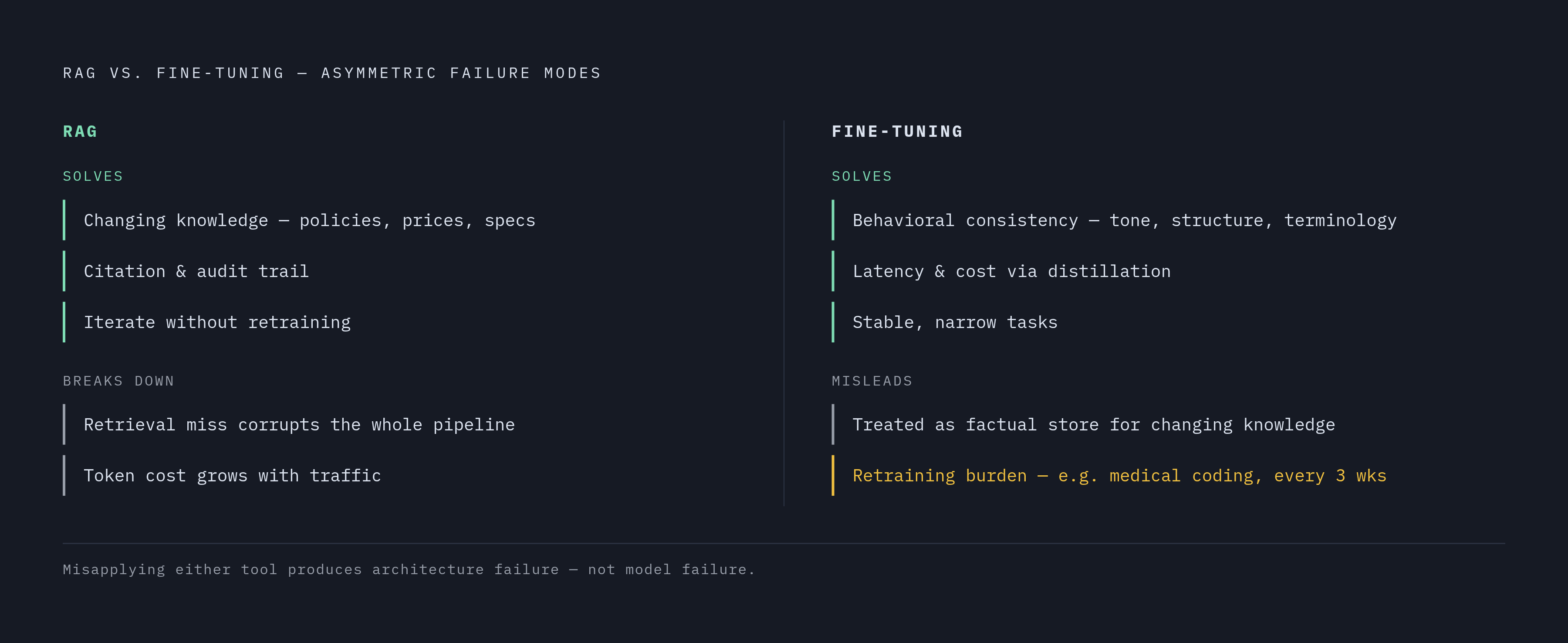
RAG is suited to knowledge that changes and answers that must point to evidence. Updating documents refreshes the available facts without a retraining cycle, while keeping knowledge outside the weights allows base-model changes without rebuilding a training dataset. Retrieved documents also provide the basis for a citation trail. This is a distinct advantage in regulated workflows. Legal, healthcare, and finance applications may require an answer to be attributable to a specific document, which fine-tuning alone cannot provide.
Retrieval quality, however, constrains the whole system. If the retriever misses the relevant chunk, the generator has no evidence to draw on for a correct answer. A loosely relevant passage can be worse because it can steer the model toward a confident but incorrect response. Many apparent generation failures therefore begin upstream. A stronger base model cannot fix a retrieval pipeline that gives it the wrong information.
KAIST’s MusT-RAG research demonstrates the value of specializing that pipeline. Its music-focused vector database, MusWikiDB, makes music question-answering more accurate and uses less compute than a general Wikipedia corpus. The relevant advantage comes from retrieving text suited to the domain and the question. Production implementation consequently depends on retrieval supported by domain-aware chunking, suitable embeddings, reranking, and evaluation.
That implementation adds an operating cost. Retrieval introduces latency, and the added context consumes tokens on every request. When context sizes are much the same, those token costs rise as traffic grows. The overhead can be acceptable at lower volumes but becomes a significant recurring expense at sustained scale, creating an economic reason to examine fine-tuning for suitable tasks.
What fine-tuning actually solves, and where it misleads teams
Fine-tuning is strongest when the problem is variation in behavior. It can improve consistency in structured output, tone, persona, and domain terminology where prompting remains unreliable. Its training examples show the model what kind of response to give. That makes it a natural fit for a stable task whose success depends on repeatedly producing the same kind of output.
Distillation extends that advantage to cost and latency. A frontier model generates high-quality outputs for a narrow task, and a smaller open-weight model is fine-tuned on those outputs. The smaller model can then deliver near-frontier quality at a fraction of the inference cost and latency. The scope must remain narrow enough for those examples to represent the task. This is a stronger commercial rationale than treating fine-tuning as a general-purpose factual store.
Fine-tuned models can learn associations, but they do not reliably recover specific new facts in the way a retrieval system can. Changing facts also create recurring maintenance work. A medical coding example in the supplied benchmarks required retraining every three weeks as coding standards changed. Its accuracy advantage over RAG therefore came with continuous retraining.
The training data creates another obligation. Fine-tuning needs labeled input/output pairs that show the behavior the team wants, and a few hundred to a couple of thousand high-quality examples are a reasonable place to start when changing that behavior. Synthetic data on its own usually falls short without real examples. LoRA and QLoRA reduce training expense compared with full model retraining, but they do not remove data preparation, evaluation, or redeployment. Lower compute costs leave those responsibilities intact.
The diagnostic questions that determine which approach fits
RAG is a better fit for policies, prices, product specifications, and support documentation that change often because teams can update documents without training the model again. Stable, narrow knowledge makes fine-tuning more defensible. A fixed regulatory framework or closed product taxonomy presents a different maintenance problem from a changing support corpus. The choice begins with that distinction.
Imperial College London’s IFRS sustainability reporting study shows how this works in a domain that changes little. Its fully LLM-based pipeline had higher single-industry and cross-industry accuracy than its RAG-based pipeline in a narrow domain that changes slowly. The study built a high-quality synthetic question-answer dataset for use in training. There is an important qualification. Both architectures incorporated an industry classifier and a fine-tuned LLM, so the result supports that particular pipeline design rather than a clean claim that fine-tuning universally beats retrieval.
When a task needs citations, source attribution, or audit provenance, it still needs retrieval even if fine-tuning improves other parts of the task. If the problem instead concerns a strict JSON schema, regulatory form, clinical note, or fixed tone that prompting cannot hold, fine-tuning is the relevant lever. Factual question-answering over documents points back to RAG. Requirements that span both categories can justify a combined architecture.
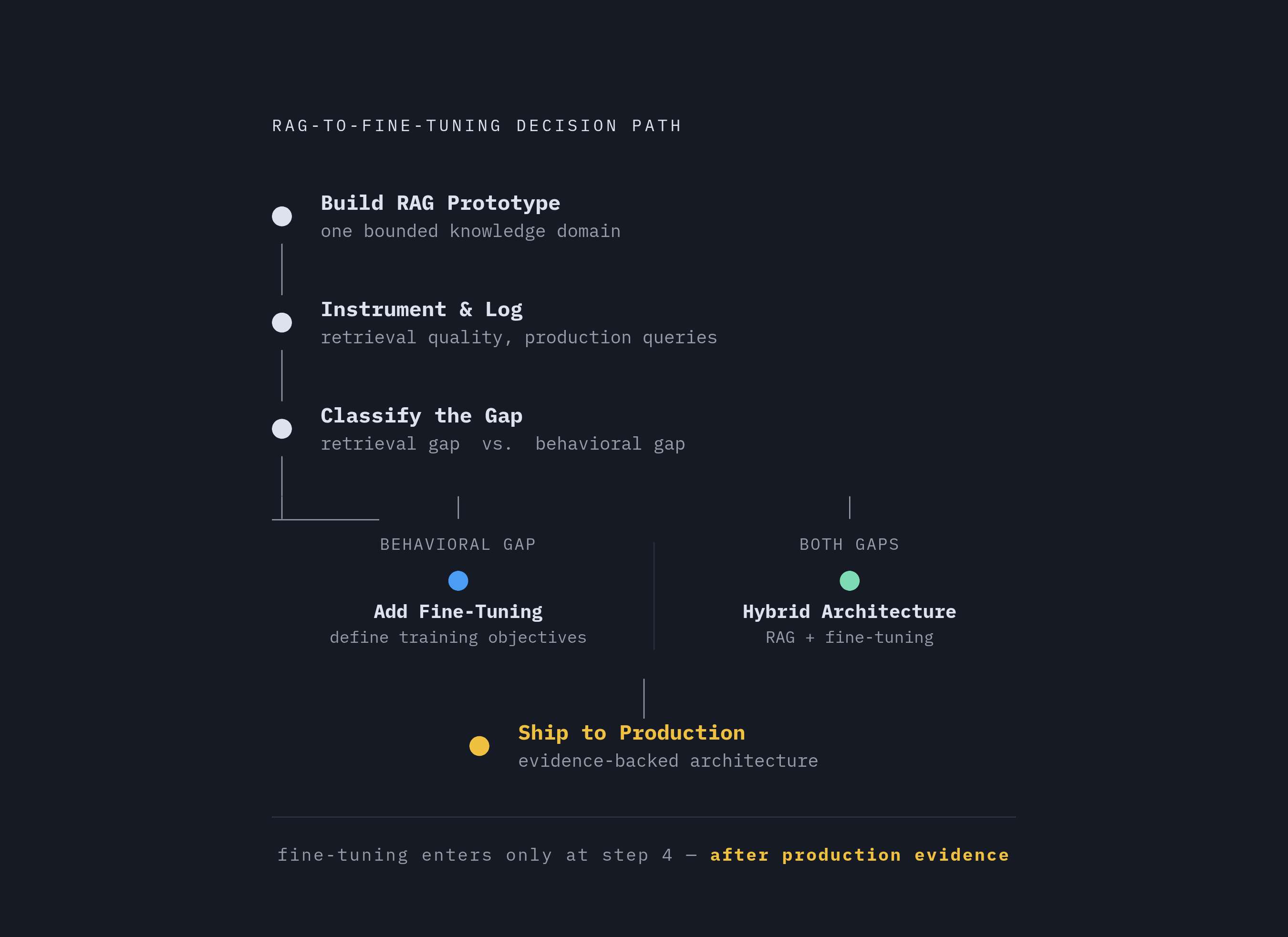
RAG has lower startup costs and supports iteration through chunking or reranking changes without retraining. Fine-tuning adds data preparation, training, evaluation, and redeployment, with preparation often exceeding compute costs when datasets are not clean and versioned, though its lower inference cost can offset that investment at scale and frequent knowledge changes move the crossover point. The practical sequence is to establish a RAG baseline, identify behavioral failures it cannot resolve, and define training objectives from those failures.
What production cases reveal about each approach under real conditions
Shell used the NVIDIA NeMo framework for domain-adaptive pretraining and supervised fine-tuning with an initial focus on chemistry. Standard language models misinterpreted queries and matched them to broad information rather than domain-specific insights, a problem framed as a retrieval challenge. NVIDIA reports that accuracy on Shell’s custom benchmark rose enough to matter compared with the untuned model. The diagnostic fit is specialized language interpretation. Training helped with patterns the base model kept misunderstanding, going beyond what more documents alone could do.
PayPal’s Commerce Agent presents an economic case. Fine-tuning with the framework substantially reduced retrieval latency and monthly GPU costs while maintaining competitive quality. The requirement was not simply a more knowledgeable model. A narrow, latency-sensitive task at high query volume made inference efficiency an important part of the architecture decision. The outcome supports weighing fine-tuning against both the ongoing costs of running it in production and the cost of training.
CrowdStrike’s April 2026 cybersecurity work adds another domain-specific application. The company used the same tooling on Google Cloud’s Managed Training Clusters on Gemini Enterprise Agent Platform, with NVIDIA Blackwell GPUs, to fine-tune Nemotron and other open LLMs. The work targeted threat detection, investigation, and response. Training was a fit here because the tasks were specialized, needed structured output, and were sensitive to latency. That fit does not establish that every changing cybersecurity fact belongs in model weights.
The research cases expose different boundaries. MusT-RAG outperformed traditional fine-tuning on both in-domain and out-of-domain music question-answering benchmarks, where broad coverage and new artists, releases, and events favor external knowledge. Its framework also uses context during inference and fine-tuning, making it more informative than a simple retrieval-only label suggests. The IFRS study occupies the other end of the spectrum. Its standards changed slowly and its training dataset was built for the task, which helped justify a design that relied more on training, though teams cannot assume the same holds in their own domains.
Why hybrid architectures emerge from production experience, not from theory
Microsoft’s stateful RAFT framework reports 84.2% Case Hit at initial symptom presentation in enterprise troubleshooting, outperforming vanilla RAG and HippoRAG2 in that comparison. The work was accepted to EMNLP 2026 Industry Track. The broader Retrieval-Augmented Fine-Tuning approach has also outperformed standalone RAG and standalone fine-tuning on domain-specific question-answering benchmarks. These results support combining the mechanisms for defined tasks. They do not establish that every application needs both.
RAFT addresses a specific weakness in retrieval-based answering. It trains the model on examples containing retrieved context so that it learns to reason over relevant documents and ignore distracting chunks. The knowledge still arrives through retrieval. Training improves how the model uses that evidence, rather than requiring all useful facts to become internal associations. This separates factual access from the behavior needed to interpret it.
That division explains the practical hybrid configuration. RAG handles the parts of a workflow where knowledge changes or citations are needed, while fine-tuning handles the parts where output format or domain terminology must stay consistent. Production queries can supply evidence for the training objective. Routing classifiers offer a further direction by sending simple formatting tasks to prompting, knowledge questions to retrieval, and suitable domain reasoning tasks to fine-tuned inference. This remains an emerging architecture.
The additional complexity needs a demonstrated purpose. A hybrid creates two systems to maintain, more demanding evaluation, and a longer path to the first result than either approach alone. Better benchmark performance does not erase those costs. Teams should therefore avoid building hybrids speculatively and add training only when a single approach demonstrably fails on a requirement. RAG-first sequencing defers that investment until production evidence makes its purpose explicit.
Applying the framework: how Phantom Farm structures domain knowledge injection for production teams
For teams seeking an implementation partner, Phantom Farm is an option that follows this RAG-first, hybrid-when-proven sequence. Its approach covers domain-aware chunking, embedding selection suited to the content, reranking, evaluation, and iterative retrieval improvement. Those components address the upstream failures that otherwise appear as poor answers. Governed outputs are part of that design. The citation trail is treated as a core deliverable for applications such as legal, healthcare, and finance.
The same approach supports a narrower training intervention when production data establishes a behavioral gap. Fine-tuning on a smaller open-weight model can be layered onto the retrieval foundation without rebuilding it. The implementation choice is therefore not a commitment to retrieval alone. It provides a path to training without making training the default answer to every failure.
Other implementation approaches fit different operating conditions. A team building its own fine-tuning or domain-adaptive pretraining pipeline needs the datasets and compute budget to support that work. Open research frameworks offer a route to hybrid systems but require substantial engineering to operationalize. Managed RAG services lower the barrier to an initial deployment. They typically provide less control over chunking, reranking, and domain-specific embeddings, so convenience must be weighed against the retrieval levers the application needs.
For a team applying this framework, the starting point is a RAG prototype scoped to one well-bounded knowledge domain. Retrieval quality should be instrumented from the beginning, and production query logs should distinguish missing evidence from inconsistent behavior. Fine-tuning can then wait until the team has a clear goal for training. Before making a choice, the team should ask whether updating the knowledge base tomorrow should require retraining. If the answer is no, fine-tuning is not the right factual foundation, regardless of an isolated benchmark advantage.
Methodology & sources
- LLMs to Support a Domain Specific Knowledge Assistant
Supplied the IFRS sustainability reporting study comparing a fully LLM-based pipeline with a RAG-based one in a slowly changing domain.
- MUST-RAG: MUSical Text Question Answering with Retrieval Augmented Generation
Provided the MusT-RAG findings on a domain-specific vector database and on retrieval outperforming traditional fine-tuning for music question-answering.