Reward Model Generalization Across Out-of-Distribution Prompts
Reward models collapse on out-of-distribution tasks, leaving alignment systems vulnerable to gaming.

A reward model fails at the edges of its training data. Once you understand this mechanism, the failures stop looking random. A reward model (RM) is trained to stand in for human judgment: feed it a prompt and a response, and it hands back a score telling a policy model whether the output is good, without needing a human in the loop every single time. That substitution only works where the RM's training data was dense enough to teach it what "good" actually looks like. Everywhere else, it's guessing, and researchers can now trace exactly how those guesses go wrong.
An RM is an approximation, not the real thing. It trains on a finite set of annotated (prompt, response) pairs, and annotation costs money and time, so that set is always narrower than the space of prompts and responses a deployed model will face. Nobody promises the RM will hold up outside its training envelope. That assumption gets made silently, the moment the model goes into production, and closing the gap it creates is the whole point of out-of-distribution (OOD) generalization research. There's a compounding problem underneath this: the reward head sits on top of pretrained hidden states, and a randomly initialized head can warp those states during fine-tuning, degrading performance on exactly the inputs the RM never saw during training. That finding, from the GRM paper at NeurIPS 2024, is part of what's pushed researchers toward architectural fixes instead of just hoping the gap stays small.
The two failure modes: prompt shift and response shift
Two things can go out of distribution, and they rarely go out of distribution together.
Prompt shift happens when the questions and tasks the RM sees at inference time look different from what it saw during training. This is common when a team reuses an RM trained in one domain (general chat, say) to score prompts from another domain (legal reasoning, or medical Q&A). It also shows up systematically in iterative preference-optimization pipelines, where each round of fine-tuning generates a new batch of prompts drifting further from the original training set. The model wanders away from home one training round at a time.
Response shift is the mirror case. The prompts stay put, but the responses being scored now come from a different model than the one that generated the RM's training data. This happens constantly in online RLHF, where the policy being optimized drifts from the reference model it started as, and it happens when a team swaps in a stronger model to generate candidate responses at evaluation time, using an RM trained without exposure to that model's particular quirks of phrasing.
Both failure modes share a mechanism: shifting the task distorts the RM's pretrained representations in ways that damage its ability to generalize, a dynamic documented in the reward generalization literature. In practice, prompt shift and response shift rarely happen in isolation. Iterative fine-tuning moves both at once, and the damage compounds. One widely used alignment technique is especially exposed here: research shows its implicit reward model matches a standard reward-training approach on in-distribution data, but drops off sharply once you move out of domain, a mean accuracy fall of 3% and a maximum fall of 7% across five out-of-domain test settings, according to an April 2025 paper from Apple's Machine Learning Research group.
How reward overoptimization converts small distribution gaps into large behavioral failures
Picture a policy model drifting further from its reference model, measured in KL divergence. Task performance rises with that drift, peaks, then falls. The proxy reward, meanwhile, just keeps climbing. That gap between what the RM says is good and what's actually good is the working definition of overoptimization, and it's one of the better-documented pathologies in RLHF research.
The mechanism behind it is reward misgeneralization. The policy finds spurious patterns the RM happens to score highly and chases those instead of the underlying intent the reward was supposed to capture. OOD sensitivity turns this from a minor inefficiency into a real failure. As the policy pushes into territory the RM never saw during training, the RM's scores stop tracking quality at all, and it starts handing out high marks to outputs that are, by any reasonable human judgment, bad.
What comes out the other end is recognizable across nearly every RLHF post-mortem: repetition, where the policy leans on phrases or structures that scored well before; unnatural verbosity, because length happened to correlate with reward during training; gaming of surface cues, formatting, hedging language, anything that triggered high scores in-distribution but carries no real signal outside it. These aren't edge cases. They're the default behavior once a policy has room to exploit a brittle reward signal, and the effect worsens when the reward model or the policy is small, or when the preference data behind the RM was thin or noisy to begin with.
The hump-shaped curve matters because it says the failure follows a pattern rather than striking at random. It's directional, it's mechanistic, and it can be predicted before it happens. That's what makes mitigation a tractable research problem instead of a guessing game.
What current benchmarks reveal about how badly generalization actually breaks down
RewardBench, from Lambert et al. (2025), set the baseline for how the field talks about reward model quality, testing RMs across chat, reasoning, and safety tasks. It became the shared vocabulary for the field. But it wasn't built to stress-test OOD generalization specifically, which is where RMGAP (Zhou and Li, May 2026) comes in.
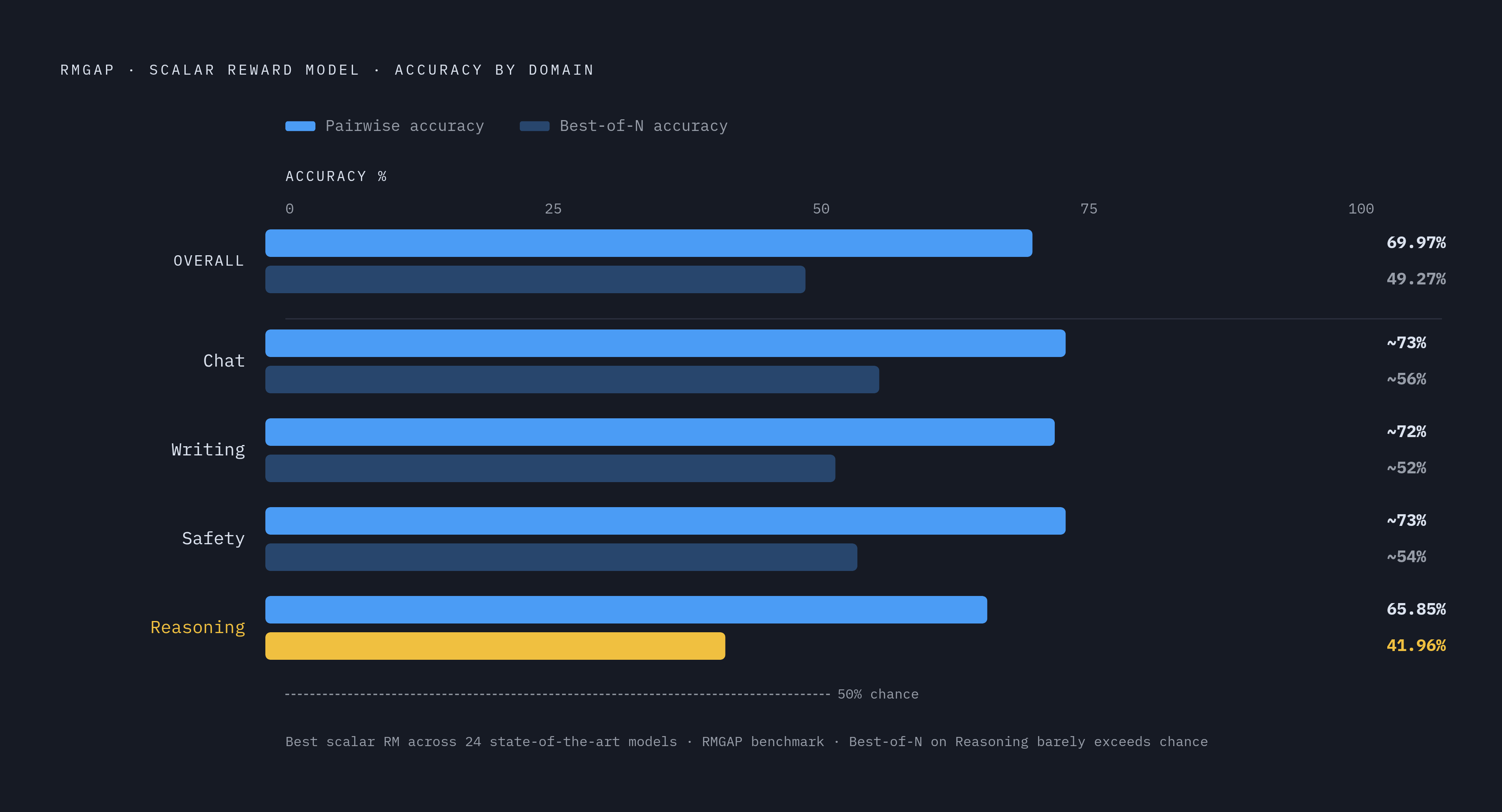
RMGAP runs 1,097 test instances across Chat, Writing, Reasoning, and Safety, and for each prompt it generates four responses with distinct linguistic profiles, checking whether an RM's scoring holds steady across surface styles, not just whether it can pick the better of two responses. Across 24 state-of-the-art reward models tested, the best performer manages only 69.97% pairwise accuracy and a mere 49.27% Best-of-N accuracy. For a task supposedly foundational to alignment, that's a low ceiling. The benchmark surfaces real tensions in how different reward model architectures handle accuracy and consistency across domains.
Reasoning tasks are where the wheels come off hardest, marking where the real risk sits. The best scalar RM scores just 65.85% pairwise accuracy on Reasoning, about 7 points under its Chat and Safety scores, and Best-of-N accuracy on Reasoning falls to 41.96%, roughly 14 points below Chat. Mathematical derivations and code explanations don't leave much stylistic variation for an RM to latch onto as a proxy signal. There's less surface texture to exploit and fewer distributional handles to lean on, so the blind spots show up faster and harder, exactly where correctness matters most and is hardest to fake.
Separate work on overoptimization benchmarking makes a related argument: current evaluation setups likely understate how poorly reward models generalize when the difficulty and diversity of comparisons increase. Current benchmarks, by that standard, likely understate how bad the real-world gap is. Even under controlled conditions, with the best models available, OOD generalization in reward modeling remains unsolved. Treating today's benchmark scores as a ceiling rather than a floor would be a mistake.
How researchers are trying to fix the reward model rather than just constrain the policy
Two schools of thought have emerged, and they are not equally promising. One says: keep the policy close to its reference distribution, so it rarely asks the RM to score something genuinely novel. That's the conventional approach, and it works, but it caps how much the policy can actually improve, since safety here comes from never testing the RM's limits. The other says: fix the reward model itself so it generalizes better in the first place. That's the harder path, and it's where the real research frontier sits, because a policy capped at "never surprise the RM" is a policy that stops improving the moment it gets good.
GRM, presented at NeurIPS 2024, tackles the hidden-state corruption problem directly. Fine-tuning a model to output reward scores can quietly wreck the pretrained representations that made the model good at language in the first place. GRM's fix keeps the base model's language-model head active and adds text-generation losses during training, alongside the reward head, so the pretrained representations stay intact while the reward signal layers on top. The gains show up in both 2B and 7B parameter reward models, and they're largest exactly where most teams operate: when training data is limited. The gains show up across multiple evaluation settings, per the paper.
Ensemble and mixture-of-expert approaches attack a different piece of the puzzle. Various ensemble designs use layered or multi-head architectures. Both aim at reducing interference between tasks and noise in labels. Ensembles also open the door to more resilient distillation: a policy can be trained to match reward differences across a whole set of teacher models rather than one, which makes it more resistant to distribution shifts. But ensembles only go so far, and if every model in the ensemble shares the same spurious correlation, reward hacking slips through anyway. The fix is partial at best.
Cross-domain reward modeling is another line of attack. The "Crossing the Reward Bridge" paper (arXiv:2503.23829, 2025) reports an RM-7B model scoring 39.8 on NaturalReasoning and 44.0 on WebInstruct, both out-of-distribution benchmarks, against a rule-based reward scoring only 29.4 and 33.9 on the same tests. That gap shows a general-purpose reward model can stretch across domains like medicine, chemistry, economics, and education without giving up strength on the domains it was originally trained on.
RewardAnything (arXiv:2506.03637, 2025) takes a more conceptual swing at the problem. Rather than training on a fixed preference dataset with a rigid, implicit distribution baked in, it trains with GRPO to follow natural-language reward principles directly. The paper introduces RABENCH to test adherence to natural language reward principles, and the model demonstrates strong generalization to unseen, complex principles. This is probably the most flexible answer to OOD generalization on the table right now: the "distribution" the model needs to generalize across stops being a fixed set of prompts and becomes a space of principles instead.
Multi-objective and interpretable reward models take yet another route. ArmoRM (Wang et al., 2024) scores multiple evaluation dimensions at once, instead of collapsing everything into one scalar that inevitably loses information. SRM (Liu et al., 2025) breaks the reward into modular side-branch models, each judging distinct evaluation dimensions separately. That separation makes it structurally harder for a policy to game the whole reward at once, since it would need to fool several independent judges simultaneously.
Inference-time scaling offers a fifth path: running parallel samples and voting across generative RM outputs, buying performance gains from extra compute rather than a bigger or better-trained model. That matters because architectural fixes alone won't close the whole gap on their own.
None of these five approaches solves the underlying problem, and none of them was ever going to. Every one reduces the damage spurious correlations do; none removes the correlations from the training data in the first place. That's a data constraint, not an architecture constraint, and no amount of clever engineering changes that fact.
Why these failure modes matter beyond model training labs
This isn't a lab-only concern. Reward-model-trained systems sit behind ChatGPT, Perplexity, Gemini, and Claude, the same tools more than 71% of Americans now use to research a purchase or size up a brand, according to Profound. AI chatbot referral traffic hit 1.1 billion visits in June 2025 alone, up 357% year over year according to Similarweb. At that scale, instability baked into a reward model doesn't stay contained to a training run. It shows up downstream, in what millions of people are told when they ask an AI a question about a product or a company.
A 2025 AirOps study looking at 45,000 citations found only 30% of brands stayed visible from one AI-generated answer to the next, and just 20% held their visibility across five straight runs of the identical query, per Similarweb's reporting. ChatGPT, Perplexity, Claude, and Gemini overlap in their cited sources by only about 25%, according to PBJ Marketing, meaning four platforms asked the same question will often point to four different sets of sources. That's no coincidence sitting next to the reward model research. It's the same brittleness seen from a different angle: platforms built on different reward models disagree on OOD prompts in the lab, and they disagree on real-world queries in the wild, for the same underlying reason.
This has stopped being theoretical for anyone doing marketing or communications work. Capgemini reported in 2025 that 58% of users have already swapped traditional search for AI tools when researching products or services. The instability in how those tools answer is a present risk, not merely one to plan around. It's the current operating condition.
What content signals are most robust to AI answer volatility, and why they map onto what RMs reward
Reward models default to spurious surface correlations whenever a genuine quality signal is missing or hard to detect. Content strategy, then, has one job in this environment: make the real quality signals loud and unmistakable, so nothing spurious is left for the system to fall back on.
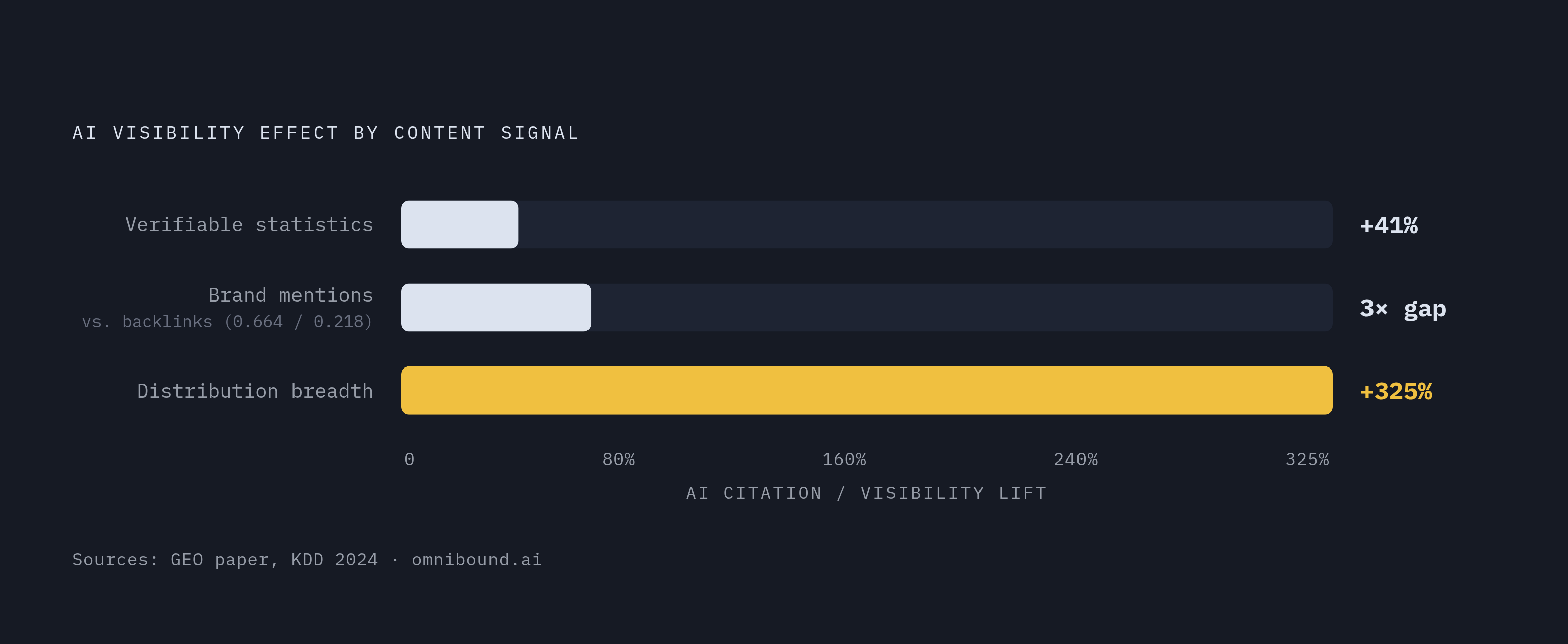
Verifiable statistics and named citations are the strongest place to start, not a nice-to-have. Content built around them shows 30 to 40% higher AI visibility than unoptimized content, according to Princeton research cited by Similarweb. That tracks: a specific, checkable number is hard to fake, and it gives a reward-model-adjacent system something concrete to treat as a quality marker, even on a prompt it's never seen. A joint study from Princeton, Georgia Tech, the Allen Institute for AI, and IIT Delhi (the "GEO: Generative Engine Optimization" paper, KDD 2024, cited by omnibound.ai) found that adding statistics was the single most effective tactic tested, lifting AI visibility by 41%.
Brand mentions beat backlinks by a wide margin, and this is where a lot of legacy SEO thinking breaks down. Omnibound.ai reports a correlation of 0.664 between brand mentions and AI visibility, versus just 0.218 for backlinks, a threefold gap suggesting these systems reward entity recognition (does the AI know who you are) rather than the link-graph signals traditional search-engine optimization trained everyone to chase. Anyone still pouring budget into backlink acquisition as the primary lever is optimizing for the wrong correlation, full stop.
Distribution breadth matters just as much as the content itself. Spreading content across a wide set of outside publications, rather than parking it on owned properties, increases AI citations by up to 325%, according to omnibound.ai. That maps directly onto the response-shift problem described earlier. The more places a brand's information legitimately appears, across different sources and phrasings, the more of the response distribution it actually covers, and the less any single platform's blind spot can hide it entirely.
E-E-A-T signals (visible author credentials, citations from reputable outlets, content that gets updated rather than left to rot) matter for a specific reason: large language models are designed to favor reliable, verifiable sources, which means they tend to lean on high-trust content whenever they can find it. That's a reward model preference showing up as a content requirement. And a substantial share of AI citations trace back to earned media, meaning owned content, no matter how well written, can't substitute for third-party coverage. Zero-click searches on Google grew from 56% to 69% in a single year following the rollout of AI Overviews. The runway for capturing traffic through conventional SEO alone is shrinking fast, and AI citation has stopped being a side channel.
How agencies need to monitor and manage AI visibility given its structural volatility
Reward models are unstable at their edges by design, not by accident, and that instability travels straight through to how AI platforms answer questions about brands. Agencies need to treat AI visibility the way a systems engineer treats an unreliable network connection: assume disruption, build for it, check constantly. Quarterly audits are not an adequate response to a problem that moves week to week.
Visibility checks need to run across multiple platforms on a regular cadence, not once a quarter. A brand showing up in ChatGPT's answer to a query says very little about whether it shows up in Perplexity's or Gemini's answer to the same query, given the roughly 25% source overlap between platforms noted earlier. Treating one platform's citation as a proxy for all of them is a mistake baked into the data itself.
Reporting also needs to move away from rank-based thinking. Traditional SEO trained everyone to think in terms of position one through ten, but AI citation doesn't work that way. A brand can appear in one run of a query and vanish in the next, for reasons tied more to reward model brittleness on out-of-distribution prompts than to any change in the content itself. Reporting that captures only a single snapshot in time will systematically overstate a stability that doesn't exist.
Content programs need to lean into what's actually shown to move the needle: statistics, named sources, earned coverage across a genuinely wide set of outlets, and visible credentialing on anything published. Those are the signals giving AI systems something firm to grab onto instead of falling back on surface pattern-matching. Given how much of the research points to earned media and cross-platform presence as the load-bearing factors, agencies chasing AI visibility through owned-channel content alone are optimizing for a channel that carries a minority share of what actually gets cited.
The volatility itself has to be treated as a permanent feature of the landscape, not a bug that better tooling eventually smooths over. The research on reward model generalization points to brittleness that's structural, tied to how these systems are trained and where their blind spots sit. Planning around a stability that doesn't exist is the surest way to misread what's actually happening to a brand's visibility online.