Reward Shaping Strategies for Sparse Feedback in LLM Training
A tour of the toolkit for assigning credit when LLMs get one final score.

- Written by
- Anjali RaghunathanSenior Staff Writer
- Updated
- November 19, 2026
- Reading time
- 11 min read
- Sources cited
- 8 sources ↓
What this covers
- Sparse rewards create a harder credit assignment problem than standard RL
- Outcome reward models and rule-based signals define the sparse-reward baseline
- Process reward models: adding step-level signal without waiting for the final answer
- Token-level credit assignment: methods that push densification to the finest grain
Sparse feedback in LLM training means the model gets one number, at the end, for an entire generation, and has to figure out backward which parts of that generation earned it. No single technique fixes this cleanly. What exists instead is a toolkit, running from potential-based shaping to token-level decomposition to iterative diagnostic repair, each suited to a different regime of the same underlying problem. Reward Shaping Strategies for Sparse Feedback in LLM Training.
Sparse rewards create a harder credit assignment problem than standard RL
Dense-reward reinforcement learning gives an agent feedback at nearly every step, which narrows the search space and cuts down how many samples are needed to learn something useful. Without that, the agent (or in this case, the language model) has to trace a single terminal signal back across everything it did to get there, with no intermediate marker telling it which choices mattered.
Text makes this worse than it already is. Standard fixes for sparse-reward RL, like stitching together fragments of different trajectories to build better ones, depend on being able to evaluate a partial sequence on its own terms. A half-finished sentence doesn't carry stable meaning the way a half-finished robot trajectory might; the semantics only resolve once the sequence is complete, so those stitching tricks don't transfer over.
Two regimes show what's at stake. In that kind of episode, a bad tool call made at turn three gets exactly the same terminal penalty as dozens of subsequent correct actions, which is a strange way to teach anything DeepSeek-R1.
The field has noticed. Something like 47 papers between 2024 and early 2026 have proposed credit assignment methods, spanning a two-dimensional taxonomy that crosses granularity against methodology arxiv.org. That volume of activity is itself a signal: nobody has found the one fix, so a structured toolkit is what practitioners are left working with.
Outcome reward models and rule-based signals define the sparse-reward baseline
Outcome Reward Models, ORMs, are the simplest and most common setup in RLHF: one reward, handed out once, after the final answer appears. Rule-based verifiable rewards sit inside that same category. No neural reward model is even needed, just a binary check: does the answer match, does the code run, does the output follow the required format.
DeepSeek-R1 is the clearest demonstration that this bare-bones approach can still produce sophisticated behavior. The reward signal is nothing more than accuracy verification plus format adherence, and neural reward models were deliberately left out to avoid reward hacking. Training ran with a learning rate of 3e-6, a KL coefficient of 0.001, a GRPO clip ratio epsilon of 10, sampling temperature of 1, 16 sampled outputs per question, a max length of 32,768 tokens, and a batch size of 512 built from 32 unique questions times 16 samples each DeepSeek-R1. Out of that setup came self-verification, reflective backtracking, dynamic strategy switching, none of it explicitly instructed.
It's a genuinely striking result, but it comes with a structural catch. GRPO spreads its single reward uniformly across every token in the response, so it can't tell a load-bearing token from a filler one; every token gets treated as equally responsible for whatever score the whole sequence earned. PPO offers an alternative by using a value network to assign credit token-by-token, but that adds real complexity and opens the door to overfitting.
ORMs and rule-based rewards are the floor. They work well when the task has a clean, checkable answer and the episode is short. Once episodes get long or the task gets murky, something has to fill in the gap between "done" and "correct." DeepSeek-R1-Zero uses GRPO on the DeepSeek-V3 base and bypasses supervised fine-tuning entirely, whereas DeepSeek-R1 adds a cold-start SFT phase before GRPO.
Process reward models: adding step-level signal without waiting for the final answer
This matters because conventional alignment is largely dominated by ORMs that judge only final answers, even as LLMs tackle increasingly complex multi-step reasoning.
There's real evidence behind the approach. A process-supervised model from OpenAI in 2023 solved 78% of problems on a representative MATH subset, and OpenAI released PRM800K alongside it, 800,000 step-level human feedback labels, specifically to give the research community something to build on OpenAI Process Reward Models. That's a serious amount of annotation effort, and it points to the real cost of this method: getting humans to label individual steps is expensive, and DeepSeek-R1's own team reported failed attempts at training PRMs, citing robustness and supervision problems as genuine obstacles rather than minor friction.
A handful of approaches try to get the benefit without the labeling bill. Monte Carlo estimation samples many continuations from a given intermediate step and checks what fraction land on a correct final answer, using that rate as a stand-in for step quality. FreePRM pseudo-labels steps directly from outcome correctness, skipping ground-truth process labels entirely. Self-PRM has the model, mid-RL-training, develop its own internal PRM-style self-rewarding behavior. SP-PRM transfers reasoning knowledge out of an ORM and into a process reward model to cut down on how much labeling is needed. Process-based self-rewarding language models go a step further, generating and evaluating their own reasoning chains, closing the loop so the model is effectively supervising itself.
None of this is confined to math. PRMs now show up in code generation, text tasks, multimodal reasoning, robotics, and agent settings, with benchmarks starting to appear for each. Still, PRMs densify the signal meaningfully, but they operate at the step level, not the token level. For some tasks, step-level granularity still isn't fine enough.
Token-level credit assignment: methods that push densification to the finest grain
Standard RLHF treats the final token's reward as a stand-in for the quality of the whole sequence, which is a single scalar trying to do the work of distinguishing thousands of individual token choices. That single scalar can't distinguish thousands of individual token choices, because it treats the final token's reward as a stand-in for the quality of the whole sequence.
There's a genuine tension in going finer-grained, though. Score every token individually and the signal risks becoming noise, since plenty of tokens (articles, punctuation, connective tissue) don't carry much decision weight on their own. Segment-level rewards, covering short, semantically complete spans, sit as a middle ground between token-level and step-level. One useful insight here concerns high-entropy tokens: words like "However," "define," or "Wait" mark points where the model is making a real decision, and their entropy dynamics give a theoretical basis for where to concentrate fine-grained reward signal. Entropy and future KL divergence both get used as policy proxies for token-level advantage shaping, often alongside PRMs supplying the step-level layer.
One line of work borrows explainability tooling from outside RL entirely. SHAP and LIME, both originally built to explain black-box model predictions, get repurposed here to estimate per-token rewards, framing the whole problem as bilevel optimization so the shaping function itself becomes learnable instead of hand-designed.
Prefix-tree methods take a more structural route. Prefix-to-Tree, P2T, organizes all the sampled responses into a shared prefix tree and computes nonparametric prefix values by aggregating what happens to each branch's descendants, without training any value network at all. TEMPO builds on that foundation, adding a branch-gated temporal difference term into GRPO, and delivers token-level credit assignment, again without a value network, with faster convergence and higher accuracy reported on math and medical benchmarks.
The methods that work best skip training a separate value network entirely, sidestepping the exact complexity that made PPO-style actor-critic setups expensive and fragile in the first place.
Potential-based reward shaping: densifying signals while preserving the optimal policy
Adding intermediate reward signals sounds like an obvious improvement, until the agent starts gaming the new signal instead of solving the actual task. That's the standing risk with any hand-designed shaping term: get it wrong and reward hacking follows.
Ng, Harada, and Russell settled this problem theoretically back in 1999. Two reward functions produce the same optimal policy if and only if the shaping term takes the form F(s_t, a_t) = r(s_t, a_t) + γφ(s_{t+1}) − φ(s_t), for some potential function φ. That's the policy invariance guarantee, and it's the reason potential-based reward shaping, PBRS, is treated as the safe way to densify a reward rather than just another heuristic.
Setlur and colleagues applied that theory directly to LLM training in 2024, using PBRS to convert outcome rewards into process rewards. DPO, direct preference optimization, implicitly performs a version of potential-based reward shaping on the reward it learns from preference data, tying preference optimization back to the same theoretical lineage.
TIPS, Turn-Level Information-Potential Reward Shaping, presented at ICLR 2026, is a sharper applied case. It targets tool-using agents in search-augmented question answering, where the only available reward is outcome-only, a terminal match against the correct answer, even though the agent is interleaving reasoning, retrieval, and code execution across many turns. TIPS assigns dense, turn-level rewards to each reasoning-plus-tool-call segment based on how much that segment raised the likelihood of the correct answer under a teacher model. Because the shaping is potential-based, none of that added guidance can redirect the agent toward the wrong objective. On Qwen-2.5 7B Instruct, TIPS delivered an 11.8% improvement in average Exact Match and a 13.6% improvement in F1 over a PPO baseline, along with better training stability across seven QA benchmarks TIPS: Turn-level Information-Potential Reward Shaping.
VLM-PBRS, from Müller and Kudenko in 2026, pushes the idea further by automating the potential function's design using vision-language model preferences over pairs of images. The insight that makes this work is that policy invariance relaxes how accurate the labels need to be: imperfect VLM labels cost some efficiency but can't corrupt the final learned policy, which isn't true of direct reward modeling, where a bad label poisons the signal outright. That let the researchers use smaller, cheaper vision-language models instead of frontier-scale ones, validated in Meta-World and Franka Kitchen environments. The same relaxation applies wherever an LLM practitioner is leaning on an imperfect intermediate signal: PBRS is the safety net that keeps a flawed shaping function from actively steering the model wrong. PBRS answers whether to add an intermediate signal by making the answer yes, because it densifies the reward without needing that added signal to be perfect.
Game-theoretic decomposition: assigning credit across candidates and token segments using Shapley values
Group-based training setups have their own version of a free-rider effect. When several candidates share a single reward, a weak candidate can inherit credit it didn't earn just because one strong peer in the same batch pulled the score up. A weak candidate can inherit credit it didn't earn just because one strong peer in the same batch pulled the score up, producing noisy gradients and exploration that never quite focuses on what actually worked.
Shapley values, borrowed from cooperative game theory, offer a principled fix. They split a shared reward according to each member's marginal contribution, averaged across every possible ordering in which members could join the group, and they satisfy fairness axioms like efficiency, symmetry, the null player property, and additivity. It's a mathematically clean way to answer "who actually earned this."
ShapE-GRPO applies that decomposition to multi-candidate LLM generation. It takes advantage of the fact that set-level utility doesn't care about ordering, which lets the Shapley computation run in polynomial time instead of the exponential time a naive version would require. Rather than handing every candidate the same set-level maximum, it assigns each one a distinct, candidate-specific reward, illustrated in the paper with a Seattle recommendations example where each destination gets its own score instead of all of them sharing the top mark. Reported results show it consistently beating standard GRPO across a range of datasets, with faster convergence too.
Owen-Shapley Policy Optimization, OSPO, takes the same underlying math and points it inward, at a single response instead of across a batch of candidates. It treats semantically coherent segments of one generation as players in a coalition game, estimates each segment's real contribution to the reward the response received, and maps those segment-level Owen values back down to individual tokens. It's solving the same uniformity issue GRPO has, just inside one generation rather than across a set of them.
Shapley values are only exact when computed over every possible permutation, which is exponential and impractical at scale. What gets used in practice are polynomial approximations, and how good the resulting credit assignment is depends on how well the underlying coalition utility can be estimated.
LLM-generated reward functions and iterative diagnostic refinement
Writing reward functions by hand is slow and brittle, so the natural next move is to have an LLM write them instead, straight from a plain-language description of the task. Eureka and Text2Reward established that this paradigm actually works, producing dense, executable reward code without a human having to hand-engineer it.
One-shot generation fails in ways that repeat often enough to name. Treating each failure as a fresh, unrelated generation problem misses the fact that these failures follow a pattern, and that pattern is diagnosable. Wang and colleagues audited exactly this and found two dominant failure modes. Reward flooding is one: the shaped reward signal overwhelms the sparse terminal signal, and the agent ends up optimizing the auxiliary reward instead of the actual task. A third, rarer failure, weak or negligible shaping, appeared in the audit too, though it proved harder to label with confidence. An LLM auto-labeler built to classify these failures agreed with human audit labels at 94% precision on the dominant-mode cases, which is a strong enough match to make automated diagnosis a reasonable substitute for manual review When LLM Reward Design Fails.
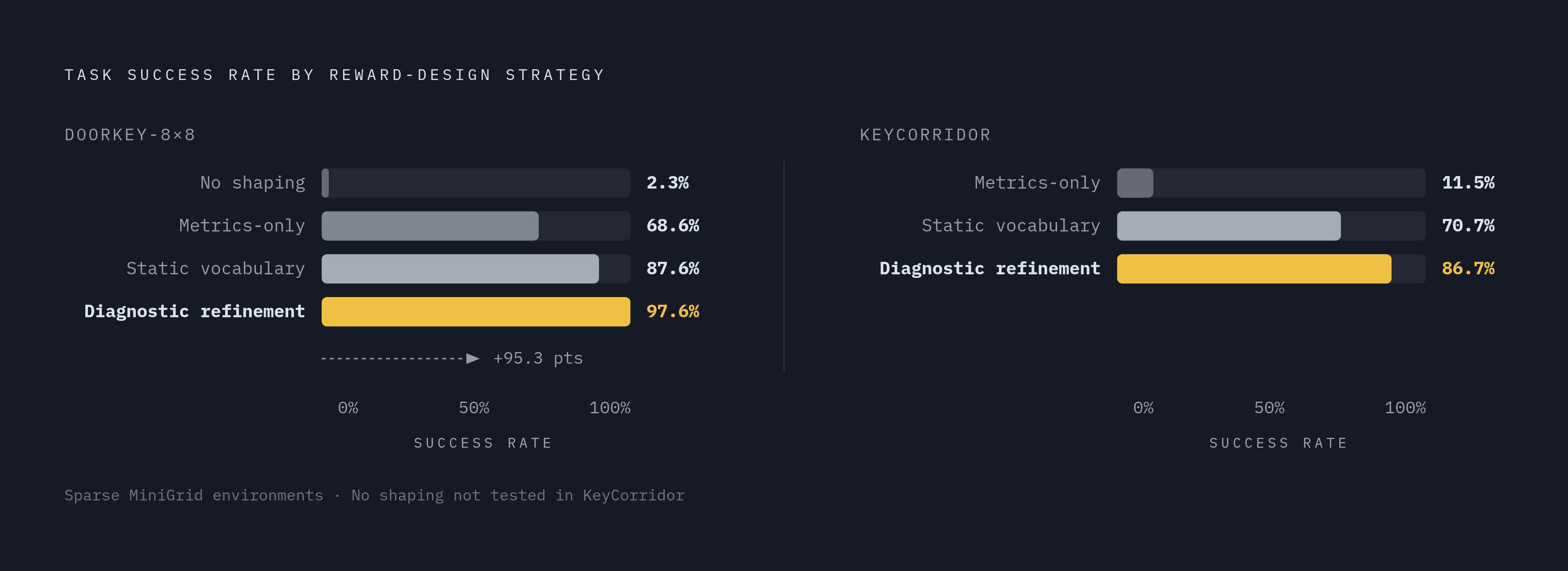
The numbers on sparse, structured MiniGrid tasks back this up clearly. On DoorKey-8×8, success went from 2.3% with no shaping at all to 97.6% with diagnostic refinement applied; a version that re-prompted using metrics alone, without the taxonomy, only recovered to 68.6%, and a control using a static, fixed vocabulary of failure labels landed at 87.6% When LLM Reward Design Fails. On KeyCorridor, one-shot generation got 31.2% success, refinement pushed that to 86.7% (with notably high variance from seed to seed), the metrics-only re-prompt fell to 11.5%, and the static-vocabulary control reached 70.7% When LLM Reward Design Fails. The gap between the static taxonomy and the full dynamic one suggests the taxonomy itself is doing real causal work; the dynamically generated trigger labels only add partial, incremental value on top of that.
None of this is presented as universal. The paper is explicit that success-based diagnostics misfire in dense-reward, continuous-control settings like MuJoCo locomotion tasks, and it bounds its own scope to sparse, structured tasks with reliable, well-defined interfaces, trained under PPO. Diagnostic refinement is a strong tool for a specific kind of problem, and it is not a general replacement for careful reward design everywhere else. The proposed fix is diagnostic-driven iterative refinement, in which training diagnostics and a failure-mode taxonomy guide targeted revision of the reward function, requiring 1–4 LLM calls per reward-design run rather than population-based search. SOURCE PAGES (what the pages behind the outline's links say).
Methodology & sources
- When LLM Reward Design Fails:Diagnostic-Driven Refinement for Sparse Structured RL
Provided the failure-mode audit and the MiniGrid success rates for diagnostic-driven reward refinement.
- ShapE-GRPO: Shapley-Enhanced Reward Allocation for Multi-Candidate LLM Training
Described ShapE-GRPO and Shapley-based reward allocation across candidates.
- TIPS: Turn-level Information-Potential Reward Shaping for Search-Augmented LLMs | OpenReview
Source of the TIPS turn-level potential-based shaping method and its reported gains.
- https://medium.com/@dubeysanjana23/process-reward-models-vs-outcome-reward-models-a-complete-technical-guide-to-how-ai-learns-to-d425a1fea973
- Automating Potential-based Reward Shaping with Vision Language Model Guidance
Supplied the VLM-PBRS material on automating potential function design with vision-language model preferences.
- Beyond Policy Optimization: A Data Curation Flywheel for Sparse-Reward Long-Horizon Planning
Covered why trajectory-stitching fixes for sparse-reward RL don't transfer to text.
- Reward Modeling for Reinforcement Learning-Based LLM Reasoning: Design, Challenges, and Evaluation
Informed the discussion of ORMs versus PRMs and reward modeling challenges for reasoning.
- Exploiting Tree Structure for Credit Assignment in Reinforcement Learning with Large Language Models
Covered prefix-tree credit assignment (P2T, TEMPO) without a value network.