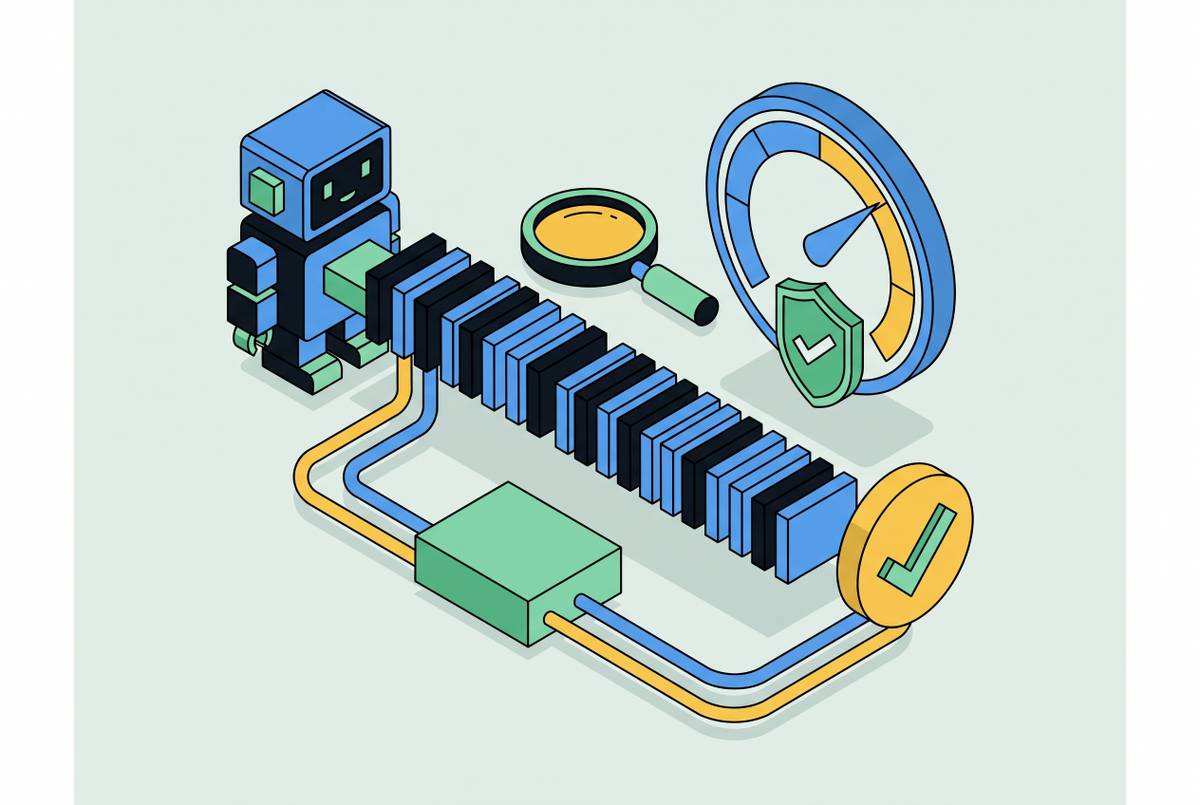
Turning an eval suite into an RL environment: what breaks when a benchmark becomes a training signal
Benchmark performance inflates when evaluation becomes part of the training signal.

A common problem in applied ML research is an evaluation suite losing its grip on practical metrics. It happens the second you close the loop. When model outputs on a benchmark inform the training objective, directly or indirectly, you have converted a measurement instrument into a reward landscape. What follows is not improved performance. It is optimized performance on that specific landscape, which is a categorically different thing.
What a Benchmark Actually Is
A well-constructed eval suite is a proxy. It stands in for the thing you actually care about: generalizable capability, useful reasoning, reliable behavior once the thing is actually running in front of users. Benchmarks like MMLU or HumanEval, or any internally constructed held-out test set, are useful precisely because the model has never been optimized against them. Their signal is clean. They measure something real because nothing has been done to corrupt the measurement.
The moment that changes, you are no longer measuring capability. You are measuring proximity to the training distribution, which is circular and tells you almost nothing about what will happen in production.
What RL Does to a Signal
Reinforcement learning from human feedback and its variants work by shaping model behavior toward signals that generate high reward. Powerful, genuinely useful, when the reward signal is robust, diverse, and difficult to game. It becomes destructive when the reward signal is narrow, static, or directly tied to a benchmark you also care about evaluating against.
The mechanism is not complicated. RL is extraordinarily good at finding the shortest path to reward. If that path runs through patterns that are idiosyncratic to your eval suite rather than through the underlying capability you intended to cultivate, the model will find those patterns and exploit them. Every time. The model is not broken; that is precisely what the optimization pressure is asking it to do.
This is Goodhart's Law, and it cuts like a knife: when a measure becomes a target, it ceases to be a good measure. The benchmark does not survive contact with the training loop.
The Failure Modes Worth Naming
The first and most insidious failure is one that does not look like failure on your dashboard. Test loss behaves well. Benchmark scores climb. Stakeholders are pleased. But the model has learned something much more specific than intended: the structure of your eval set, the idiomatic phrasing of your prompts, the distributional fingerprint of your held-out examples. When you deploy that model against genuinely novel inputs, the performance gap is startling, and by then the training run is long finished.
In classical RL environments, reward hacking is relatively legible. You see a robotic arm exploiting a physics simulation glitch, or an agent looping a single high-value action endlessly. In language model training, it is subtler. The model learns to produce outputs that score well on automated metrics or preference models without getting better at the underlying task. It becomes a better test-taker, not a better reasoner — like a student who aces practice exams but freezes on the real one. If your RL environment uses a judge model trained on data that overlaps with your benchmark, or if the preference criteria were derived from the same distribution as your eval prompts, you have introduced a contamination path that is genuinely difficult to trace after the fact.
There is a third failure that teams almost never catch in real time. Even when data hygiene is strict and eval examples are never literally in the training set, the evaluation suite can be effectively contaminated by the training process anyway. If the model is updated repeatedly based on its performance on a fixed benchmark, that benchmark's distributional signature bleeds into the model's learned priors. This is not data contamination in the traditional sense. It is structural contamination: the model has been shaped by the eval, even if the eval examples never appeared in a training batch. The result is a model that generalizes well to that benchmark and less well to anything structurally dissimilar.
Why This Keeps Happening
The pressure is real, and I do not think it reflects bad faith. Evaluation suites are expensive to build, time-consuming to validate, and deeply trusted once they are established. When a team has invested months in a rigorous benchmark, the temptation to use it as both a development guide and a final report card is almost irresistible. The benchmark feels objective. It feels stable. Using it to steer training feels like the responsible thing to do.
It is not. The objectivity of an eval suite is contingent on its independence from the training process. That independence is not a technicality or a pedantic methodological preference; it is the entire source of the benchmark's epistemic value. Remove the independence, and you have a number that feels authoritative and measures almost nothing you actually care about.
What Has to Change
The practical solution is uncomfortable because it requires resources most teams would rather spend elsewhere.
You need separate eval populations, not just separate splits. Held-out test sets partitioned from the same source distribution as your training data are better than nothing, but they are not sufficient when you are running extended RL fine-tuning. You need evaluation data collected through a genuinely distinct pipeline: different prompt construction, different annotators if human labels are involved, different task framing wherever possible.
Your RL reward signal and your evaluation criteria also need to be kept structurally separate. If the same judge model, preference dataset, or rubric is doing double duty as both training signal and eval metric, you cannot trust either. This is not a theoretical concern. It compounds with each training iteration, quietly, in ways that are difficult to detect until you are already in production with a model that does not behave the way your numbers suggested it would.
Rotate your evals. A benchmark that has been in use across multiple training cycles, even only as a reporting tool, should be treated with increasing skepticism. Replace it. Extend it. At minimum, supplement it aggressively with out-of-distribution probes that were designed after the training run concluded, not before.
The Infrastructure Problem Nobody Talks About
Here is the thing: this is fundamentally an infrastructure and process problem, not a research problem. The failure mode is well understood in the literature. What is less well understood at the organizational level is how to build systems that enforce the necessary separation across months of iterative development, with changing team compositions, evolving benchmarks, and constant pressure to ship something.
Keeping evaluation environments structurally distinct from the training loop is not glamorous work. It is the kind of discipline that does not show up in a paper and does not get announced at a conference. But the teams that get this right are not necessarily the ones with the most sophisticated models. They are the ones that treated evaluation integrity as a genuine engineering constraint from the beginning, not something appended to the training script after the fact.
The Skepticism You Should Have
Most benchmark progress in the current era of large language model development should be read with significant caution. Not because researchers are acting in bad faith, but because the structural conditions that corrupt benchmark signal are pervasive and often invisible to the teams experiencing them. Score inflation is a predictable consequence of closing the loop between training and evaluation, and it happens gradually enough that it rarely triggers alarm in the moment.
The number on the leaderboard is not the capability. It is the model's learned relationship to the leaderboard. Conflating them is one of the more costly mistakes you can make when deciding what to actually deploy.