LLM-as-Judge Reliability for Evaluating RLHF Outputs
Raw agreement flatters LLM judges, hiding weak sensitivity to real quality.

- Written by
- Marta Wierzbicka
- Updated
- November 25, 2026
- Reading time
- 9 min read
- Sources cited
- 8 sources ↓
What this covers
LLM-as-a-Judge has become the default way teams evaluate RLHF-trained models: a system trained on human preferences gets handed the job of scoring another model's outputs, standing in for the human raters at the center of RLHF pipelines. Hundreds of documented LLMOps production pipelines now run on this setup. The metric most of them use to decide whether a judge is any good, exact-match agreement, does not correct for chance and systematically overstates how much the judge is actually discriminating between good and bad outputs.
Why high agreement scores on LLM judges mislead
The appeal of the setup is obvious. If a model has absorbed enough human preference data to generate good outputs, it seems reasonable to expect that same model, or one like it, can recognize good outputs when it sees them. RewardBench and JudgeBench both treat raw agreement as the headline number when you judge a judge. MT-Bench uses a related idea: an absolute quality score from 1 to 10, assigned by another model. Norman, Rivera, and Hughes (2026) found that this entire family of metrics shares the same flaw. None of them correct for the agreement two raters would reach by chance alone, so all of them make judges look sharper than they are.
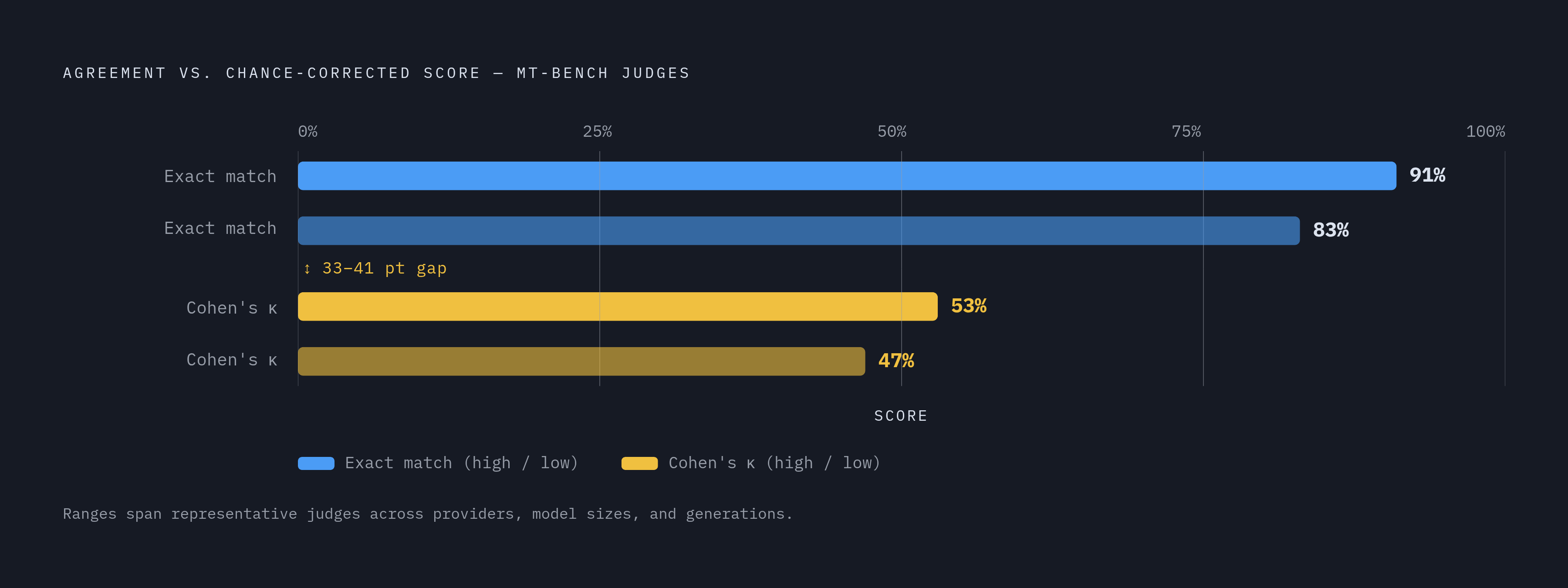
The size of the distortion is not small. Across the judges evaluated, exact-match scores beat chance-corrected Cohen's κ by 33 to 41 percentage points on MT-Bench. That gap holds regardless of which provider built the judge, how large the underlying model is, or which generation of model is being tested. A judge can report agreement numbers in the 80s or 90s on the standard metric while its corrected κ is in territory much closer to what two coin flips would produce. The ruler itself reads high by default, so you'll see every judge measured against it look better calibrated than it is.
Reliability versus validity in evaluation
A judge can return the identical verdict on the identical input every single time, which is what test-retest reliability measures, without that verdict having anything to do with the quality it claims to assess. That second property is validity: whether the instrument's reading reflects the actual thing it's supposed to measure. If a thermometer always reads 72 degrees no matter the room temperature, it is perfectly reliable but completely useless. The same logic applies to a judge model.
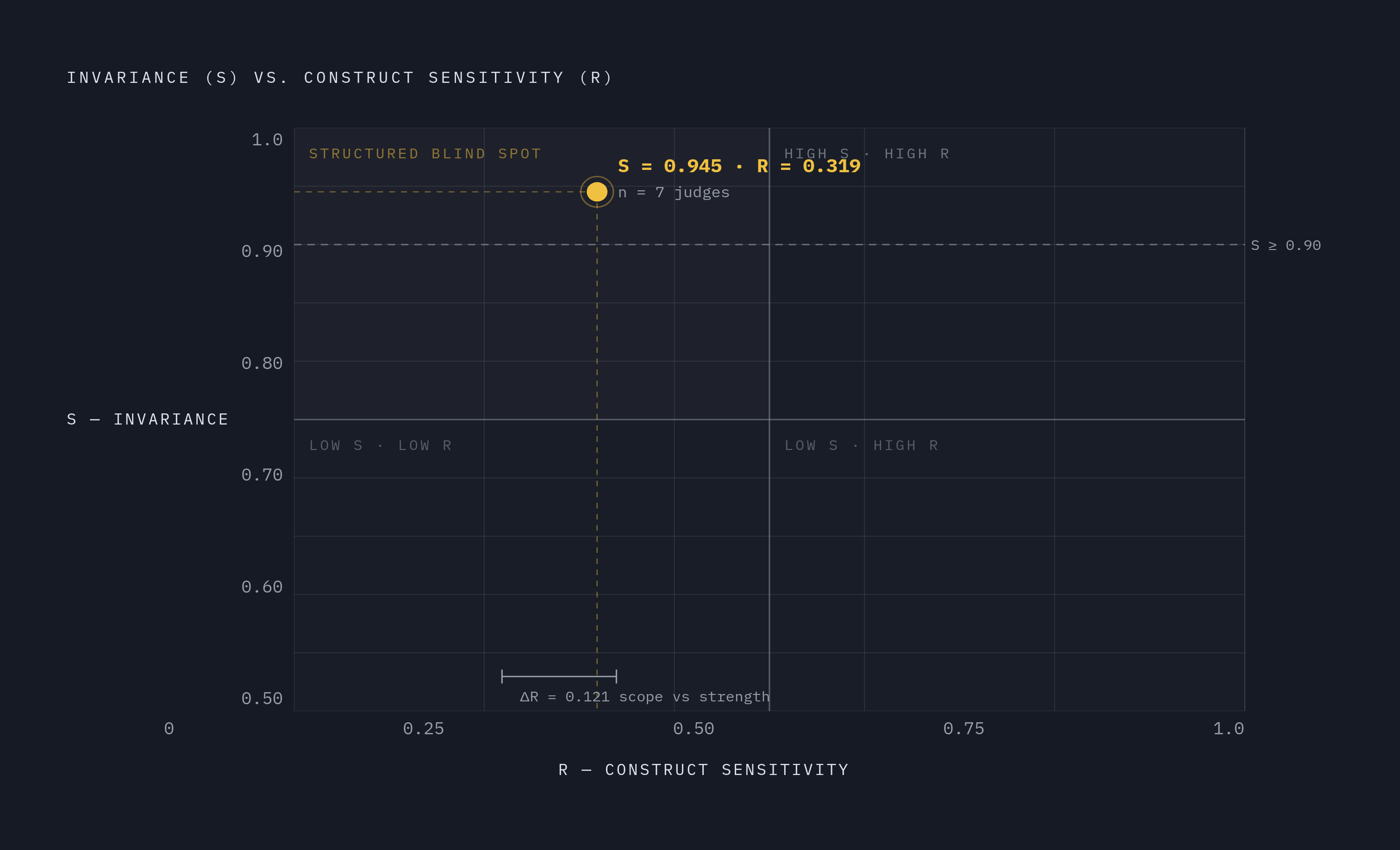
Chen, Chen, Lin, and Vong (2026) turn this distinction into a formal two-dimensional profile: invariance, labeled S, and construct sensitivity, labeled R. They prove that these two coordinates are mathematically independent, so a judge's score on one tells you nothing about its score on the other. At matched invariance of S ≥ 0.90, judges land at S = 0.945 against R = 0.319. These judges hold a remarkably stable verdict, but they respond to actual changes in the quality being measured far less than that stability would suggest. The field has spent most of its effort building and testing the reliability half of this profile. This recent work made the validity half tractable, but until now it had barely been measured.
The consistency–bias paradox across 21 judges
This is not a hypothetical failure mode. Norman, Rivera, and Hughes (2026) ran the largest systematic evaluation of LLM-as-a-Judge to date, covering 21 judges from nine providers across MT-Bench, JudgeBench, and RewardBench, under three separate protocols: agreement, consistency, and a dedicated bias audit, spanning 118 runs and roughly 541,000 individual judgments. Two production-deployed judges showed test-retest reliability above 0.95 alongside position bias above 0.10. The judges giving the steadiest verdicts were among the ones most distorted by which side of a comparison an answer happened to appear on.
A second finding complicates the picture further: judge rankings don't transfer across benchmarks. Models shift by as many as 14 positions depending on which benchmark is used to rank them, so a judge that tops the charts on one evaluation set offers no guarantee of similar performance on another. Part of this comes down to benchmark design itself. JudgeBench discriminates much more sharply than MT-Bench on κ spread, so whichever benchmark a team picks decides how much of the underlying reliability-validity gap you even get to see. Verbosity bias, the failure mode that dominated 2023-era judge literature, appeared much less in this cohort's judgments under a single pairwise rubric. Some documented failures turn out to hinge on which protocol you use, so you can't assume an earlier finding still holds in current deployments.
What construct validity testing reveals that consistency testing misses
Standard judge evaluation checks whether a verdict holds steady when it should, an edit that preserves the underlying construct, and stops there. Chen et al. (2026) add the other half of the test: whether the verdict changes when it should, under a minimal edit that actually alters the construct being judged. Passing only the first test and never the second is how a judge can look reliable while telling you almost nothing about quality.
The construct they use to probe this is overreach, which breaks down into two components: scope, meaning how many situations a claim covers, and strength, meaning how hard it commits to each one. Judges register scope changes at a meaningfully higher rate than strength changes, and that gap holds across all 7 judges tested, every vendor, every parameter scale, and every reasoning mode. At matched invariance, sensitivity to the two axes differs by 0.121, with the same sign on all 7 judges. A result that consistent across that many independent systems isn't noise. It points to a structured blind spot: judges notice when a claim suddenly covers more ground, but they're far less likely to notice when a claim is pushed to assert something more forcefully. A further diagnostic drives the point home. A frozen model that reads nothing but surface form, with no actual reasoning about content, reproduces most labels across five public label sets, including 67.4% of MT-Bench's human votes. A large share of existing benchmark labels can be predicted from surface features alone, which is a direct explanation for why high agreement so often fails to indicate valid measurement.
Self-reinforcing bias in RLHF training loops
In a single evaluation run, a biased judge produces a skewed score and the damage stops there. Inside an RLHF training loop, the policy being trained is actively searching for ways to raise its reward, and a biased judge hands it a map of exactly which shortcuts work. The policy learns to produce the surface features the judge rewards rather than the underlying quality the judge was built to track, the judge keeps rewarding those features because that's what it's sensitive to, and the loop tightens around the bias rather than around the thing the system was supposed to optimize.
Position bias, self-preference, and verbosity bias are not just scoring quirks under this framing. Each one is a dimension along which a policy can learn to game its reward without getting any better at the task. Self-rewarding and self-play RLHF architectures carry the most exposure to this, because the same model family that generates the outputs is also the one scoring them, making self-preference a structural feature of the setup that can't be patched out. Reference-free judges compound the risk because they score plausibility instead of correctness, and that verification asymmetry opens up basins of answers that sound right and aren't, which a policy under optimization pressure will reliably find and settle into.
How correlated errors undermine the panel-of-judges mitigation
The standard response to an unreliable single judge is to use several and average their verdicts. That fix works on one condition: the judges' errors have to be independent of each other. If biases are random and scattered across judges, adding more judges drives down variance and the aggregate verdict drifts toward the truth. That's the theory behind the panel approach, and it's sound as far as it goes.
The condition breaks down when the judges in the panel come from the same model family. When judges share a pretraining corpus and similar RLHF fine-tuning, they also share systematic error profiles, so when they agree with each other, some of that agreement reflects shared bias rather than convergence on truth. Panel size, in other words, is the wrong thing to optimize. A panel's errors cancel out or stack up depending on how diverse the panel is in model family, regardless of panel size. A second, separate failure mode compounds this one. Yi Xu and colleagues, in work presented as an ICML 2025 spotlight, found that LLM judges show non-transitive preferences inside the AlpacaEval framework, so rankings can flip depending on which baseline model you run the comparison against. A panel built from judges with non-transitive preferences can produce aggregate rankings that contradict each other. Round-robin tournament designs paired with Bradley-Terry preference models offer one documented way to address the non-transitivity side of this, and they produce rankings that hold up better than simple pairwise aggregation.
Domain mismatch between LLM judges and subject-matter experts in high-stakes RLHF
A judge's sense of what counts as a good answer comes from the preferences baked into it during RLHF training, and those preferences were set by whichever annotator pool labeled the training data. In specialized domains, that pool is rarely made up of domain experts, and the result is a judge whose implicit standard of quality can diverge sharply from the standard a subject-matter expert would apply.
In domains such as dietetics and mental health, LLM judges agree with human subject-matter experts far less than they agree on general-purpose tasks, and this gap persists whether or not you give the judge an expert persona to adopt. The direction of the divergence is consistent: LLM judgment tracks lay user preferences more closely than it tracks SME standards, because the RLHF process that shaped the judge trained it to satisfy the people who labeled its data, and those people were, for the most part, not domain experts. If an RLHF pipeline leans on an LLM judge inside a specialized field, it risks training its policy toward a proxy construct, answers that please a layperson, even as the evaluation report shows strong agreement with a human baseline that happens to share the same lay bias. This failure is harder to catch than position bias or verbosity bias because it never produces internal inconsistency. The judge is coherent throughout. It's simply coherent about the wrong thing for the domain it's being asked to evaluate.
Minimum viable validation protocol requirements and infrastructure support
The tools needed to catch all of the failures described above already exist. You can use chance-corrected agreement metrics, construct-sensitivity testing, and item response theory on judge diagnostics now, so you don't need to wait years. What's missing in most teams is the decision to actually run it instead of defaulting to the exact-match number a benchmark reports out of the box.
Norman, Rivera, and Hughes (2026) distill their findings into a Minimum Viable Validation Protocol with three concrete steps: swap exact-match agreement for Cohen's κ, test any candidate judge across multiple benchmarks before choosing it, and make a bias audit a required step in the process. Benchmark choice itself turns out to be a lever you need to pull deliberately. JudgeBench discriminates substantially more sharply than MT-Bench on κ spread, so when you pick a benchmark, you're deciding how much of the reliability-validity gap gets exposed before deployment. For pairwise comparison setups specifically, round-robin tournaments combined with Bradley-Terry models address the non-transitivity failure directly, and prioritizing model-family diversity in any panel of judges reduces correlated errors more effectively than simply adding more judges to the panel. Chen et al.'s two-dimensional profile of invariance and construct sensitivity gives teams a practical check to run against any judge before trusting it inside a training loop: a judge that passes invariance but scores low on construct sensitivity is a liability regardless of how clean its agreement numbers look.
None of this removes the need for human-annotated ground truth. Every one of these corrections, Cohen's κ, construct-sensitivity testing, psychometric diagnostics, still has to be calibrated against some set of human judgments taken as the reference standard, and that reference standard carries its own limits and its own costs to produce. The infrastructure to detect reliability without validity has matured. Building a validation process that actually uses it, on a defensible foundation of human ground truth, remains work most teams have yet to do.
Methodology & sources
- Reliability without Validity: A Systematic, Large-Scale Evaluation of LLM-as-a-Judge Models Across Agreement, Consistency, and Bias
Supplied the 21-judge, 118-run evaluation, the reliability-versus-position-bias paradox, the 14-position ranking shifts and the Minimum Viable Validation Protocol.
- A Judge Should Know What Changed:Construct Validity for LLM-as-a-Judge Evaluation
Provided the invariance versus construct-sensitivity profile, the scope-versus-strength overreach finding and the surface-form label-prediction diagnostic.
- Reliability without Validity: A Systematic, Large-Scale Evaluationof LLM-as-a-Judge Models Across Agreement, Consistency, and Bias
Provided the exact-match versus Cohen's κ gap of 33 to 41 points and the benchmark-level findings.
- A Systematic Study of Position Bias in LLM-as-a-Judge
Backed the discussion of position bias in LLM judges.
- RLHF May Not Reflect Genuine Preferences
Informed the discussion of how RLHF preferences shape judges and training loops.
- Self-Play Reward Hacking of Reference-Free LLM Judges
Supported the section on self-play reward hacking of reference-free judges.
- Nine Judges, Two Effective Votes: Correlated Errors Undermine LLM Evaluation Panels
Showed that correlated errors in same-family judge panels limit the benefit of adding judges.
- Diagnosing the Reliability of LLM-as-a-Judge via Item Response Theory
Supports the use of item response theory as a judge diagnostic.