Flash Attention Integration in RLHF Training Pipelines
FlashAttention cuts attention memory, but RLHF pipelines need three more optimizations.
Standard self-attention scales with sequence length at O(N²) in memory, and that quadratic term is what turns long-context RLHF training from an engineering inconvenience into a wall practitioners hit directly. This piece explains why that wall exists, what FlashAttention actually changes about it, and where RLHF-specific demands push past what FlashAttention alone can fix.
Why standard attention breaks RLHF at long context
A per-layer attention matrix grows by orders of magnitude as sequences move from moderate to long context, and RLHF training is squarely in that long-context regime, particularly for chain-of-thought and agentic tasks where reasoning traces stretch across thousands of tokens. That matters more in RLHF than in standard fine-tuning because the rollout-generation phase, the inference step that produces the completions being trained on, already consumes the large majority of total training runtime on its own, the OpenRLHF paper shows. The attention cost inside the policy-update step then stacks on top of that existing time budget rather than replacing it. RLHF runs through three distinct pipeline stages, rollout generation, reward scoring, and policy update, and each one touches attention differently, so a memory blowup at any single stage is enough to stall the entire training loop. Gradient checkpointing and mixed precision help with weight memory and general activation memory, but neither one changes how the intermediate attention matrix grows with sequence length, which is the actual constraint once context gets long.
What FlashAttention does to GPU memory
FlashAttention's speedup doesn't come from approximating attention or pruning it down with sparsity. It comes from changing where the computation happens inside the GPU's memory hierarchy, and that distinction is the key to understanding what the technique can and cannot solve. Standard attention materializes the full N×N attention matrix in HBM, the GPU's high-bandwidth but slow memory, forcing many expensive round-trips instead of using the tiny but fast on-chip SRAM. FlashAttention instead breaks the query, key, and value tensors into tiles small enough to fit in SRAM, computes attention block by block, and recomputes intermediate values during the backward pass rather than storing them, which brings self-attention memory down from O(N²) to O(N). The output is mathematically the same as standard attention, with only the memory access pattern changed, and the technique is described as IO-aware exact attention.
The generational history shows a steady push toward squeezing more out of each hardware generation. FlashAttention-3 was built for Hopper-architecture GPUs, H100 and H200, and overlaps HBM loads with SRAM computation through asynchrony and low-precision execution paths, adding a substantial speedup on top of FlashAttention-2. FlashAttention-4 continues that optimization work on Hopper and whatever succeeds it, though specific throughput numbers aren't yet established in the available sources. Across every version, one property holds: none of them approximate attention or lose information along the way.
Three RLHF-specific pressures that vanilla FlashAttention does not address
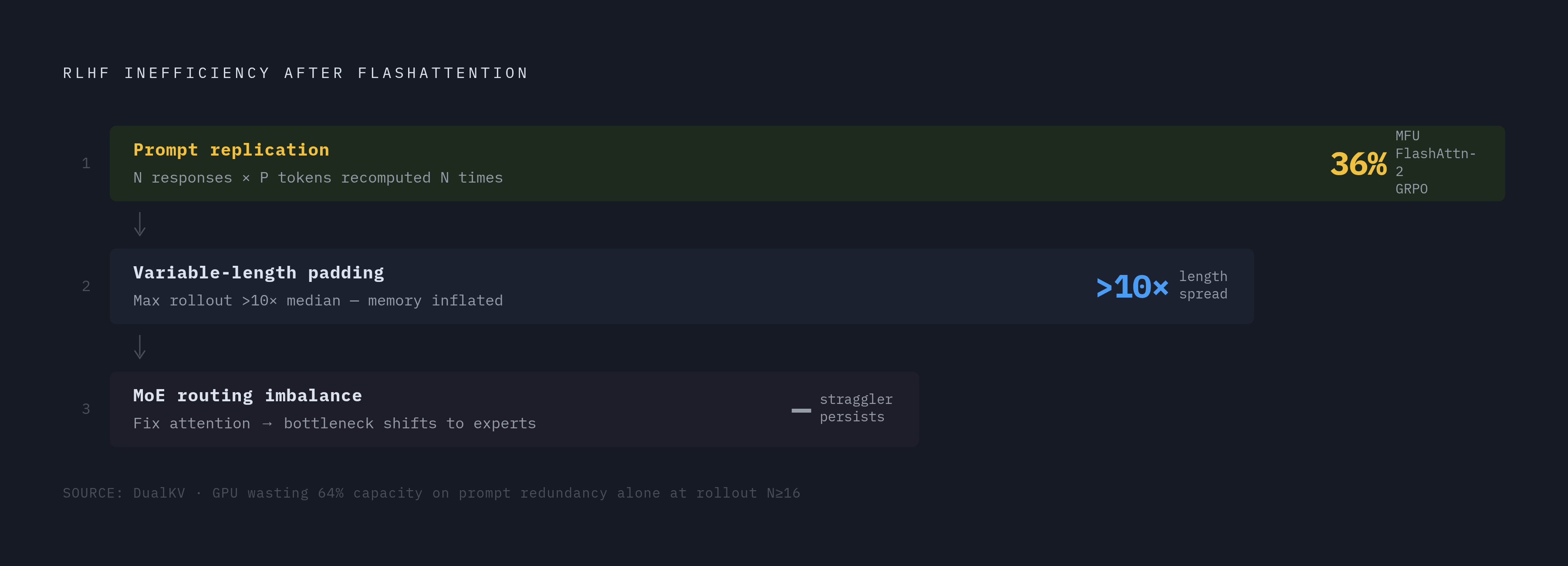
FlashAttention solves the quadratic memory wall for a single forward and backward pass over a single sequence. RLHF pipelines impose structural demands on top of that which a generic FlashAttention integration leaves completely untouched, and treating "we use FlashAttention" as equivalent to "we've solved the memory problem" is the mistake that costs practitioners the most GPU time.
The first pressure is prompt replication waste. Methods like GRPO and DAPO sample N separate response sequences from one shared prompt, but standard FlashAttention processes the P prompt tokens N separate times across both the forward and backward pass, duplicating compute over hidden states that are identical across all N copies. At rollout sizes of 16 or more sampled against long context, this redundant prompt computation dominates the entire policy-update cost, outweighing the cost of the actual attention arithmetic, the DualKV paper finds.
The second pressure is variable-length rollouts and the padding waste they create. Each rollout in a batch finishes at a different length, and padding every sequence out to the length of the longest one wastes memory and compute in proportion to how much those lengths vary. In reasoning and agentic tasks that variance runs high: ROLL Flash finds the longest responses can exceed the median by more than an order of magnitude.
The third pressure is specific to Mixture-of-Experts models trained under RL. MoE training couples two separate load-balancing problems at once: sequence composition, which sets the dense attention workload per microbatch, and token routing, which sets the sparse expert workload per expert-parallel rank. Optimizing attention alone just shifts the bottleneck over to expert assignment instead of removing it.
DualKV's own measurements make the scale of the first problem concrete: standard FlashAttention-2 reached only 36% Model FLOP Utilization during GRPO training at realistic rollout sizes, with most of the GPU's available capacity going toward redundant prompt computation rather than useful work. A natural question follows: couldn't sequence packing handle both the replication and padding problems at once? Packing does address padding waste, but it doesn't touch prompt replication. It still passes N separate copies of the prompt's key-value states through the kernel, and it introduces its own correctness hazard around sequence boundaries that has to be tracked explicitly.
How sequence packing and block-diagonal masking handle variable-length rollouts
Sequence packing is the standard first fix for padding waste in RLHF pipelines, but it isn't something a team can drop in without changes elsewhere: it depends on explicit tracking of sequence boundaries to keep attention correct. The idea is to concatenate several variable-length sequences into one flat tensor rather than padding each to the batch maximum, and the attention kernel then enforces block-diagonal masking so that tokens belonging to one sequence can't attend to tokens from another sequence packed alongside it.
The boundary-tracking requirement is where teams most often get this wrong. A cumulative-lengths tensor, or an equivalent position-ID offset array, has to travel through the pipeline alongside the packed sequence, because the packed representation on its own loses the metadata that marks where one sequence ends and the next begins.
Evidence at the framework level backs up how much packing helps on its own. Packing provided the largest relative boost, compared to non-packing baselines, on datasets with shorter median overall lengths, such as HH-RLHF and TLDR, while the highest absolute speedups belonged to MetaMath-DPO.
Packing's limitation is specific: it solves padding waste, not prompt replication. The Prefix Grouper approach that DualKV's authors cite applies prefix sharing at the framework level, but it still passes the entire N-replicated key-value state through standard FlashAttention-2 underneath. The O(N·P·d) memory bottleneck from prompt replication stays in place.
Some teams have moved toward PyTorch's FlexAttention for variable-length workloads instead, since it lets a developer define custom mask functions directly rather than writing a custom CUDA kernel, accepting some raw throughput cost in exchange for not maintaining kernel code. That's a legitimate trade-off for a team weighing engineering overhead against peak speed, limited to cases where that trade is worth making over packing.
DualKV: eliminating prompt replication at the kernel level
Prompt replication can't be fixed by rearranging data at the framework level, because the redundant computation still reaches the attention kernel itself and gets executed there regardless of how the batch is assembled upstream. Solving it requires changing what the kernel does.
DualKV, from Gai et al. (2026), starts from a structural property of decoder-only models: causal masking guarantees that a prompt token's representation is identical across every one of the N response sequences sampled from it, at every layer of the network. That means the shared prompt only needs to be processed once rather than N times, but no earlier FlashAttention variant had exploited that property for training specifically. Prefix caching at inference time already takes advantage of something similar, but training introduces a complication that inference never faces: the backward pass has N sequences simultaneously writing gradients into the same shared key-value buffer, which requires atomic accumulation using fp32 accumulators and a final cast back down to match FlashAttention-2's per-element precision.
DualKV's solution has two parts. The first is a set of fused CUDA kernels, covering both the forward and backward pass, that iterate over two separate key-value regions inside a single kernel launch: the shared prompt context and the per-sequence response. The second is a redesign of the data pipeline within veRL that repacks what would have been N copies of the prompt plus response tokens per microbatch down into a single shared prompt plus N response token layout, which carries the same token-reduction logic from the attention kernel out to the rest of the model.
The measured results are substantial. DualKV also extends to hybrid sliding and global attention patterns with a head dimension of 512, something FlashAttention-2 can't support at all since FA2 is capped at d≤256, and it integrates with Ulysses sequence parallelism, demonstrated on a large-scale GRPO run at long context.
The invariance property DualKV relies on is fragile: it holds only for decoder-only models, and encoder-decoder architectures and anything using cross-attention don't share that property, so the technique doesn't transfer to them. Custom CUDA kernels built around H100 Hopper microarchitecture also carry a maintenance cost that grows as hardware generations move on, since each new architecture may require its own kernel work to keep the same gains.
RoutePack: handling the MoE expert-routing bottleneck alongside attention
Solving prompt replication through DualKV removes one bottleneck, but for Mixture-of-Experts models trained under RL, a second one sits right behind it. Once sequence packing clears out the padding-driven attention tail, expert-routing imbalance becomes the new straggler holding back the training step.
Sequence composition sets the dense attention workload per microbatch, token routing sets the sparse expert workload per expert-parallel rank, and these two things don't naturally stay in balance together. RoutePack's approach depends on rollout-time routing replay, capturing each sample's expert demand while the rollout is generated and feeding that information into the packing decision made before the training step begins, so the optimizer starts from a balanced expert load rather than discovering an imbalance mid-step.
The practical consequence for teams running MoE RLHF is that attention efficiency and expert-placement efficiency have to be co-designed rather than treated as separate problems. A team that applies DualKV to an MoE model without also addressing routing-aware packing will see its gains shrink, because the expert-routing bottleneck is still there even after the prompt-replication problem is gone. MoE RLHF has two axes of inefficiency rather than one, and only addressing attention leaves the second axis untouched.
Asynchronous rollout–training decoupling as the third dimension of efficiency
Every technique discussed so far operates at the kernel or data-pipeline level, and all of them leave one bottleneck standing that has nothing to do with how fast attention computes. ROLL Flash finds that response lengths in reasoning and agentic tasks follow a heavy-tailed distribution, where the longest responses can exceed the median by more than an order of magnitude. In a synchronous pipeline, a hard barrier sits between rollout generation and the training step, so the entire step waits on whichever sequence happens to be the slowest to finish. That means GPUs sit idle waiting for stragglers no matter how efficient the attention kernel underneath them is, which makes scheduling architecture as central to RLHF throughput as kernel design. A purely kernel-level view of efficiency, however well it accounts for prompt replication, padding waste, and expert routing, still misses this scheduling dimension, and any serious accounting of FlashAttention integration into RLHF has to treat rollout-training decoupling as a third axis sitting alongside the kernel and data-pipeline work already described.
Sources
- An Easy-to-use, Scalable and High-performance RLHF ...
- DualKV: Shared-Prompt Flash Attention for Efficient RL ...
- Part II: ROLL Flash -- Accelerating RLVR and Agentic Training with Asynchrony
- OpenRLHF: An Easy-to-use, Scalable and High-performance RLHF Framework
- RoutePack: Expert Placement and Attention-Aware Data Packing for MoE Reinforcement Learning
- Schedule-Level Shared-Prefix Reuse for LLM RL Training
- DualKV: Shared-Prompt Flash Attention for Efficient RL Training with Large Rollouts and Long Contexts
- (PDF) Enhancing Training Efficiency Using Packing with Flash Attention