Distributed Rollout Generation for Large-Scale PPO Training
Decoupling rollout generation from training eliminates PPO's sequential bottleneck.
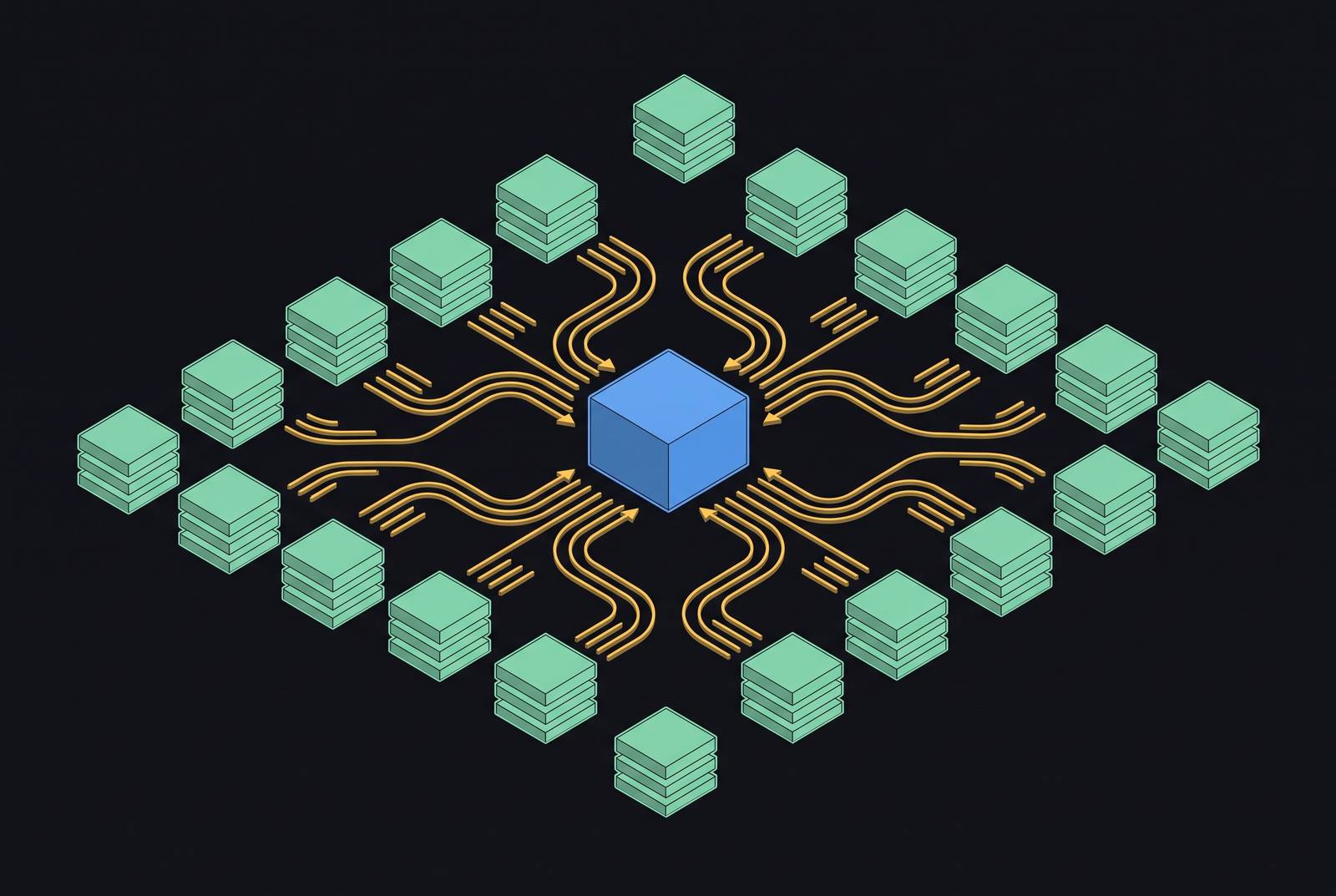
Large-scale PPO training runs into the same wall no matter whose infrastructure you're on: rollout generation, not gradient computation, eats most of the clock. The fix isn't a faster GPU. Distributed Rollout Generation for Large-Scale PPO Training
Why rollout generation is PPO's dominant cost at scale
PPO's pipeline runs in three stages, and the actor generates rollouts, then a set of scoring models (critic, reference policy, reward model) evaluate them, and the policy update trains on the result. All four models (actor, critic, reference policy, and reward model) sit in a strict sequential dependency chain, so no stage can start until the prior one finishes. Nothing runs ahead of its turn.
The damage compounds because response lengths aren't uniform. A batch of prompts produces a distribution of output lengths, and a handful of unusually long responses stalls the entire batch: the GPUs assigned to prompts that finished early just sit there, waiting on the stragglers. In DAPO 32B training, this rollout phase eats roughly 70% of total wall-clock time, veRL's own documentation states, and throwing more compute at the problem doesn't help, because the bottleneck is sequential dependency, not raw resource scarcity. You can add GPUs all day. The long tail is still the long tail.
Standard training libraries make this worse with slow decoding paths. Teams bring in dedicated inference backends like vLLM or SGLang specifically to speed up generation. Even with a fast backend bolted on, though, a colocated design (rollout and training sharing the same cluster) still leaves the learner idle in stretches while generation runs. The inference engine got faster. The architecture around it didn't change.
Three architectural responses to the rollout bottleneck
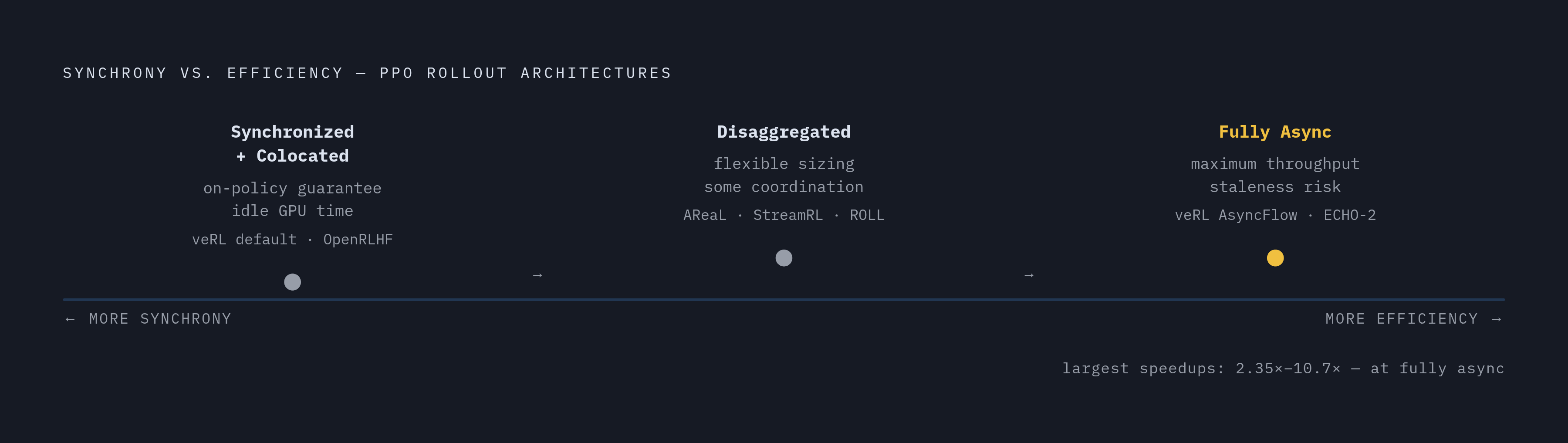
The baseline setup, still the default in a lot of shops, is synchronized and colocated: rollout workers and the learner share the same GPU cluster and move through the same iteration cycle. This gives a strict on-policy guarantee, since every training step consumes samples generated by the current model, and that guarantee is worth something. But it comes at a real cost: the learner idles while rollout runs, GPU time that could go toward gradient computation instead gets spent on forward-pass-only inference work, and whatever long-tail latency appears in generation propagates straight into training latency, raising training latency. veRL's default synchronous mode and OpenRLHF's standard path both live here.
The second rung is disaggregation: rollout workers and training workers get their own separate resource pools, sized independently. That independence buys flexibility, more inference nodes when a task needs long generations, more trainer nodes when the gradient passes are heavy, while usually staying inside a shared data-center fabric with provisioned interconnects. AReaL, StreamRL, LlamaRL, and ROLL all represent this design point.
The third rung drops synchronization entirely. Trainer and rollout worker decouple completely, with no per-step barrier forcing them to wait on each other; rollout workers stream results into a shared buffer or queue, and the trainer just consumes continuously. veRL's fully async mode, AsyncFlow, and the wide-area system ECHO-2 are all in this category. Samples the trainer consumes may have been generated by a policy checkpoint that's already out of date. That's a built-in tradeoff. It's the central tradeoff the rest of this piece has to reckon with.
These three rungs sit along a continuum rather than forming discrete boxes. They're points along a synchrony-versus-efficiency continuum, and most production systems mix and match rather than picking one rung and staying there.
The staleness problem that asynchrony introduces
Staleness is the gap, measured in training steps, between the policy that generated a rollout and the policy currently being trained when that rollout finally gets consumed. It isn't even uniform within a single batch: different sequences in the same asynchronous rollout batch can trace back to different model checkpoints, generated at different points in time. The severity scales directly with episode length. In agentic or long-context settings, coding tasks especially, some episodes wrap up in minutes while others run for hours or days, and that spread makes staleness a much sharper problem than it is in short-episode settings.
A second, subtler source of drift stands apart from the first. A rollout run on vLLM or SGLang, especially a quantized variant, samples slightly differently than the same weights running on FSDP or Megatron during training. That mismatch is an off-policy signal in its own right, and it is visible even in systems that call themselves synchronous.
The research response to staleness has mostly been to manage it rather than eliminate it. M2PO, from Zheng and colleagues, constrains the second moment of the off-policy correction specifically to handle large staleness regimes. BAPO applies adaptive clipping to keep off-policy RL stable under drift. GAC, from Xu and colleagues, watches for elevated cosine similarity between consecutive gradients as a signal of asynchronous instability, then applies a gradient-alignment correction once staleness is bounded.
That's a genuine philosophical choice as much as an engineering shortcut. Suppressing staleness back to zero means reintroducing the synchronization barriers that asynchronous design was built to remove. This line of research finds that the more productive move is to stabilize training algorithmically around stale data rather than re-engineer the staleness away. Every system covered below embodies some specific answer to the same underlying question: how much staleness is tolerable, and what's done about the rest.
Systems that decouple rollout from training
A tunable parameter, staleness_threshold, lets practitioners set how stale a sample is allowed to get before it's dropped from training, which turns the staleness tradeoff into something you can dial rather than something baked into the architecture.
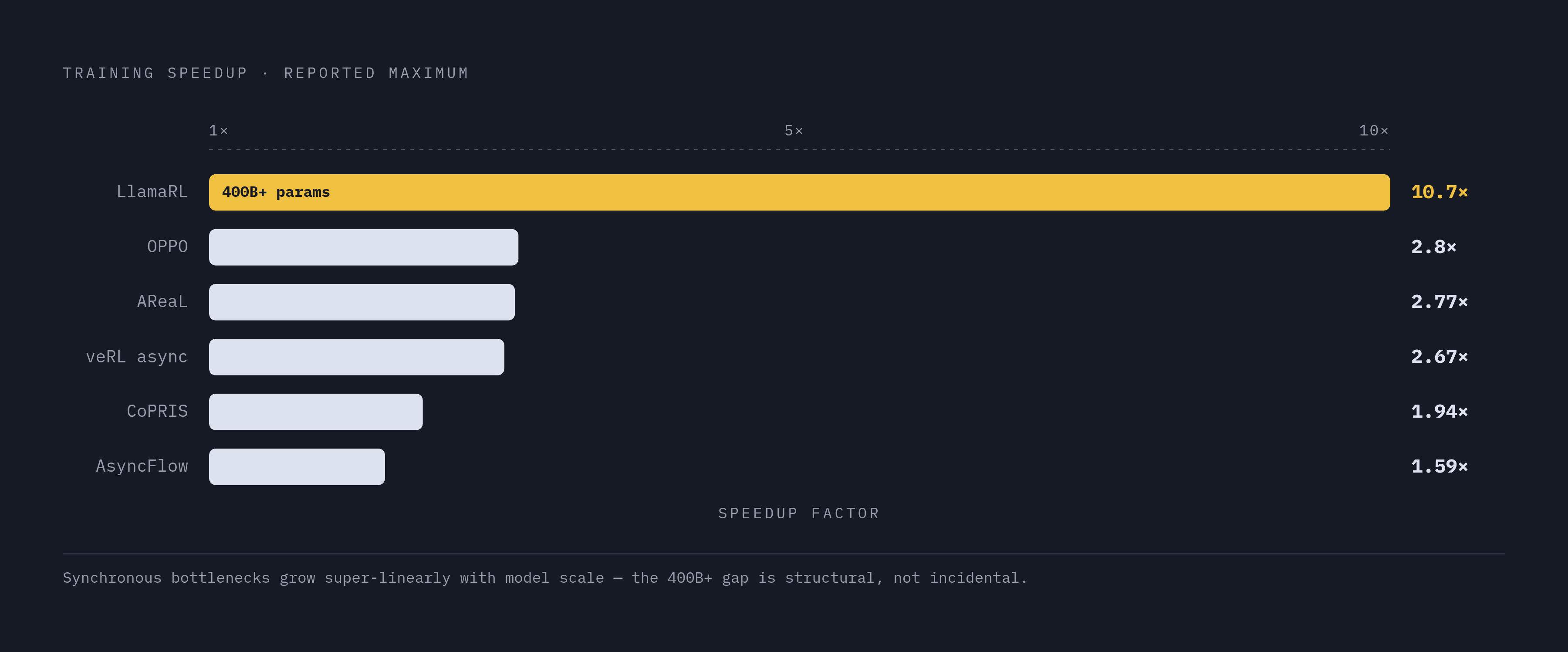
It reads more like a research blueprint than a production-hardened system, with the staleness-aware weighting scheme as its defining contribution. veRL's fully async mode achieves a 2.35×–2.67× performance improvement training Qwen2.5-7B on 128 GPUs, without significantly affecting results. AReaL, from a 2025 arXiv paper (arXiv:2505.24298), is fully asynchronous, decoupling generation from training with staleness-enhanced PPO, and reports up to a 2.77× training speedup.
It's a structural signal, one that shouldn't be waved away as a typo or outlier. It reflects something structural: synchronous bottlenecks don't scale linearly with model size, they get worse faster than the model does. A cross-system observation bears this out: speedup figures cluster in the 2–3× range for mid-scale systems, while gains at 400B+ parameter scale, as in LlamaRL's reported 10.7×, are disproportionately large, suggesting the synchronous bottleneck grows super-linearly with model size.
AsyncFlow takes a service-oriented approach, built around a producer-consumer workflow with a distributed, TransferQueue-style data store. AsyncFlow reports a more modest 1.59× average throughput improvement, consistent with its emphasis on service-oriented reliability over raw throughput compared to LlamaRL or AReaL.
ROLL (Reinforcement Learning Optimization for Large-scale Learning) is built for cost-effective, fault-tolerant training at scale, and fits well for teams that need per-sample scheduling, environment and reward workers, and heterogeneous cluster management to all live inside one library, whether that's a research group running rapid experiments or a production team that needs the fault tolerance to match.
OpenRLHF, meanwhile, remains a widely used general-purpose framework and a common reference implementation for single-policy training. Version 0.8.0 added async RLHF training through a --train.async_enable flag, along with async agent RLHF via --train.agent_func_path, bringing an earlier-generation framework into the asynchronous conversation without a ground-up rewrite.
That gap is itself a data point.
Pipeline overlap and partial rollout as alternatives to full disaggregation
Not every team wants to run separate rollout and training clusters, and full disaggregation isn't the only path to recovering lost GPU time. OPPO, presented at ICLR 2026 out of UIUC and CMU, stays synchronous by design and instead goes after the idle time hiding inside each stage. Its intra-step overlap streams the actor's output in right-sized chunks so the reward model can start its prefill work while the actor is still decoding, closing the gap between one stage finishing and the next one starting. Its inter-step overlap adaptively overcommits a subset of prompts and pushes unusually long generations into future steps, which softens tail latency without throwing away the partial work already done. OPPO's bet is that you don't need to remove the synchronization barrier to get most of the benefit. You just need to stop wasting the time around it. OPPO reports up to a 2.8× PPO training speedup, raises GPU utilization by over 2.1×, and generalizes to DPO.
CoPRIS, short for Concurrency-Controlled Partial Rollout with Importance Sampling, comes out of OpenBMB and Tsinghua University. It holds a fixed number of concurrent rollouts, terminates early once enough samples are collected, and reuses whatever trajectories were left unfinished in the next round. Its cross-stage importance sampling correction concatenates buffered log-probabilities from the previous policy with freshly recomputed ones under the current policy, which functions as a lightweight stand-in for full trust-region methods. The concurrency control does double duty: it also keeps memory from overflowing and avoids the KV-cache recomputation overhead that naive over-generation tends to cause. CoPRIS reports up to 1.94× faster training on mathematical reasoning benchmarks, with comparable or superior performance to synchronous baselines.
RolloutPipe sits in similar territory to SLIME, targeting the synchronous on-policy path directly. Rather than separating rollout and training into different clusters, it pipelines trainable groups generated under the same rollout weights, changing the granularity of the handoff between rollout and trainer. The intervention happens right at that boundary: finer-grained batching, not architectural separation.
Taken together, these three systems make the case that pipeline overlap and partial rollout recover real efficiency without requiring a team to stand up and operate a second cluster. Whether that tradeoff is worth it against full disaggregation comes down to infrastructure and operational complexity, not to which approach is more clever.
Rollout distribution at wide-area scale and the cost structure it enables
ECHO-2, submitted to arXiv in February 2026, pushes the disaggregation idea to its logical extreme: keep centralized learning on a small, stable set of datacenter GPUs, and push rollout generation out to a heterogeneous pool of inference workers connected over wide-area networks. The reasoning behind it is straightforward once stated. Rollouts are mostly forward passes and reward evaluation, and neither of those needs the expensive, low-latency interconnects that gradient synchronization depends on. RL training, in other words, doesn't care where its trajectories came from.
ECHO-2 runs on a bounded-staleness model: the learner will consume any rollout whose generating policy lags no more than S training steps behind current, where S is set by whoever's running the system. That temporal slack is what absorbs wide-area network latency without ever stalling the learner. Staleness here is treated as a dial rather than a flaw to minimize. It's a dial: ECHO-2 treats S as a system-level parameter that trades rollout cost against training stability, backed by a closed-form provisioning rule relating training time, broadcast time, and per-worker throughput, which tells an operator how much aggregate rollout capacity is needed to keep the learner fed.
Distributing the policy itself is its own problem at wide-area scale, and ECHO-2 handles it with a peer-assisted pipelined broadcast: workers form peer-forwarding chains, relaying newly received policy snapshots onward immediately and starting rollout generation as soon as the new weights land locally. That spreads the broadcast load across the whole fleet's bandwidth instead of choking a single distribution source.
The robustness numbers give the approach a concrete operating envelope. Performance holds steady at moderate staleness, S at 6 or below, but pushing staleness to 11 leads to divergence. That's not a soft warning; it's a hard boundary the paper actually measured.
The economic case, arguably the more important point, drives all of this. Geographically distributed cloud instances and opportunistic compute are abundant and cheap relative to datacenter GPU clusters, and offloading the dominant time cost, rollout, to that cheaper hardware is a structural cost reduction, not just a performance optimization.
NVIDIA's ProRL Agent, part of NeMo Gym, points at where this logic ends up. It reframes rollout generation as a service: a scalable API that handles the full agentic rollout lifecycle, rather than a pipeline stage wired tightly into a specific trainer. It ships standardized, extensible sandbox environments for agentic tasks in rootless HPC settings, and has been validated across software engineering, math, STEM, and coding RL tasks as an open-source release. Rollout, in this framing, is a call you make rather than a stage you own.
None of this comes free. Wide-area rollout distribution maximizes cost efficiency precisely by maximizing exposure to staleness and coordination complexity. ECHO-2's contribution isn't pretending that tension away, it's giving operators a provisioning rule that makes the tradeoff something they can actually see and set, rather than something they discover empirically after training has already started to diverge. Experiments involving GRPO post-training of Qwen3-4B, Qwen3-8B, and up to 32B parameter models across distributed rollout pools and real wide-area bandwidth regimes showed reward quality comparable to strong centralized baselines
Sources
- ECHO-2: A Large-Scale Distributed Rollout
- ECHO-2: A Large-Scale Distributed Rollout Framework for Cost-Efficient Reinforcement Learning
- CoPRIS: Efficient and Stable Reinforcement Learning via Concurrency-Controlled Partial Rollout with Importance Sampling
- ACCELERATING PPO-BASED RLHF VIA PIPELINE OVERLAP
- ProRL Agent: Rollout-as-a-Service for RL Training of Multi-Turn LLM Agents
- Reinforcement Learning Optimization for Large-Scale Learning: An Efficient and User-Friendly Scaling Library
- Recipe: Fully Async Policy Trainer — verl documentation
- [2505.24298] AReaL: A Large-Scale Asynchronous Reinforcement Learning System for Language Reasoning