Checkpointing and Reproducibility in Multi-Stage Post-Training
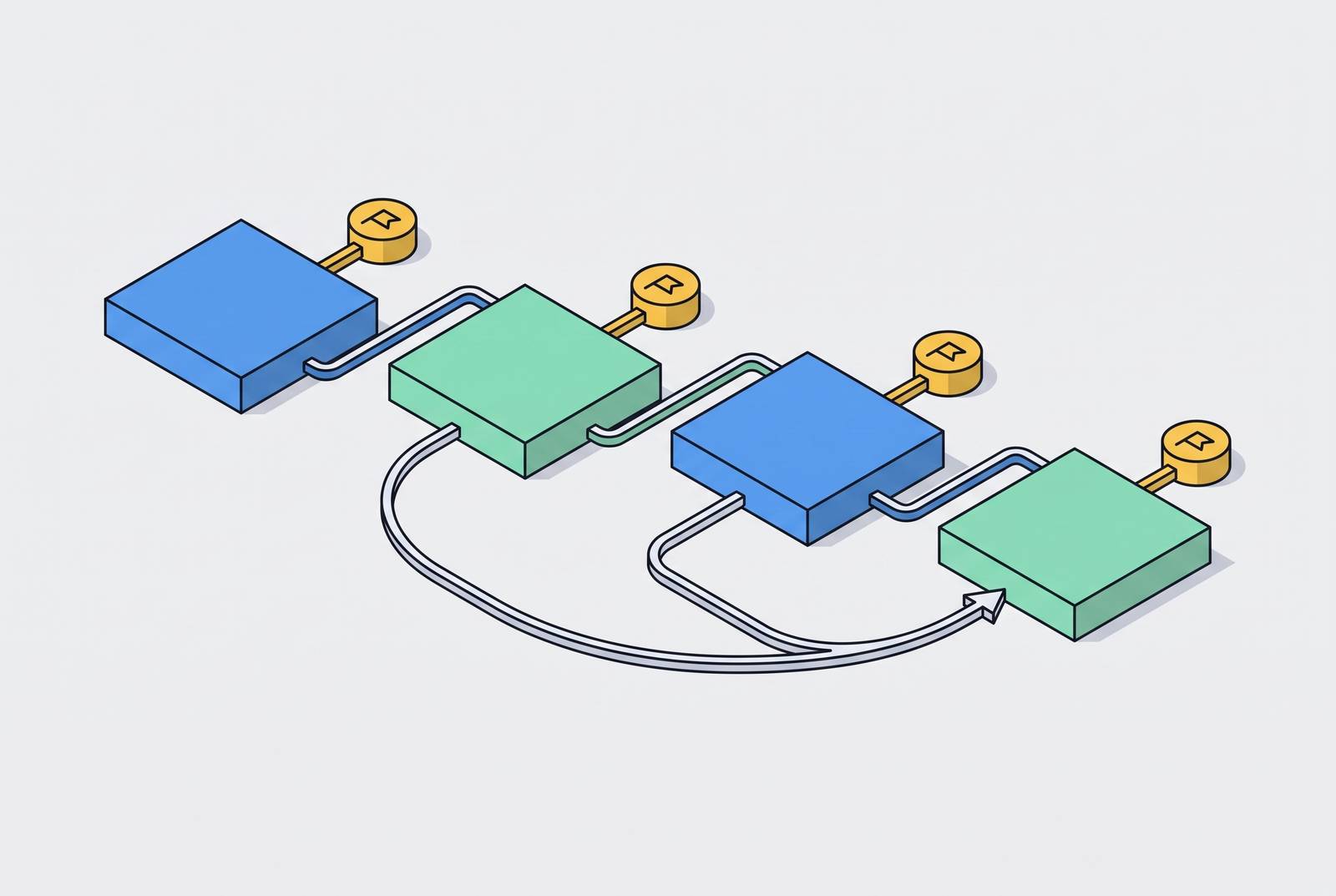
Checkpointing across the sequential stages of post-training, from continual pre-training through supervised fine-tuning, reward modeling, and reinforcement learning, is the infrastructure that lets a pipeline be resumed, reproduced, and audited. Treating it as a crash-recovery feature, a way to survive a GPU failure and pick up where a run left off, understates what the problem actually is.
Checkpointing in multi-stage post-training as an infrastructure problem
The intuitive fix to any checkpointing worry is to save more often. That intuition holds for a single training run on a stable cluster, where the only risk is losing recent progress to a hardware fault. It breaks down at the boundary between post-training stages: the handoff from one stage to the next is the transfer of an entire training state from one system configuration, one optimization regime, and one set of assumptions into another. A checkpoint in this context has to carry far more than a snapshot of weights. It has to capture optimizer momentum, the exact position in the learning-rate schedule, RNG seeds, gradient accumulation buffers, and step counters, because every one of those elements is needed to reconstruct the training state exactly, not approximately.
Post-training pipelines are sequential and heterogeneous by construction. Each stage, continual pre-training, SFT, reward modeling, RL, hands its accumulated state to the next as a starting condition, and the quality of that handoff determines the quality of everything downstream. A fault-tolerance framing asks only whether a checkpoint survived a crash. It does not ask whether the checkpoint that survived is the right one to hand off, or whether it can even be loaded by the next stage's hardware and parallelism configuration. Fault tolerance and stage-selection correctness are different failure modes entirely, and conflating them under the single word "checkpointing" is what makes reproducibility hard to see until it has already caused damage.
Three distinct problems get collapsed under that one word, and separating them is the only way to reason about any of them correctly. The first is I/O efficiency: can the training state be saved fast enough, and often enough, without stalling the GPUs doing the actual work? The second is parallelism portability: can a checkpoint saved under one hardware and sharding configuration be loaded under another? The third is stage-selection correctness: of all the checkpoints saved during a stage, is the one actually handed to the next stage the one that should be? Each of these has its own failure modes, its own mitigations, and its own body of recent systems work. The rest of this argument takes them in turn.
What a checkpoint must contain at every stage boundary, and why partial saves silently corrupt downstream stages
A checkpoint that omits optimizer state, RNG seeds, or step counters does not just force a noisier restart. It introduces a systematic bias that compounds through every stage that follows. Optimizer momentum carries the accumulated gradient history that shapes the direction and magnitude of the next parameter update. Losing that history at an SFT-to-RL handoff means the RL optimizer begins from a statistically different position than the one the SFT run actually converged to, even if the weights themselves look identical. The two runs are two different runs that happen to share a starting set of weights, not the same run restarted.
RNG seed state governs data ordering and dropout masks during training. Resuming without it means the training loop either replays batches it has already seen or samples a different sequence of data than the original run would have, and the gradients that result are biased in ways that produce no error message and no stack trace. Learning-rate schedule position matters just as much: it determines where the RL stage enters its warmup or decay curve, and a mismatch there changes the effective step size for the entire RL run that follows, often for the duration of training.
Research into LLM checkpoint and restore I/O patterns describes each checkpoint as a collection of heterogeneous tensors, parameters from layers of different shapes and sizes, optimizer states, distributed across many GPUs and grouped into shards. That heterogeneity means a partial save is structurally inconsistent, because the pieces that are missing are not interchangeable with the pieces that remain. The dominant failure mode here is silence: a checkpoint written during an unstable step, or one that simply drops optimizer state, loads without triggering any system-level fault, and the training that follows diverges from what it should have been without anyone being told why. In a multi-stage pipeline, that divergence gets attributed to the next stage's hyperparameters or its data, not to the checkpoint artifact that actually caused it, which makes root-cause analysis expensive and often inconclusive.
Completeness of the checkpoint artifact is necessary, but it is not sufficient. Even a checkpoint that captures every element of training state correctly still has to be loadable by the next stage, and that is where parallelism reconfiguration enters the picture.
How parallelism reconfiguration at stage boundaries turns a valid checkpoint into an incompatible artifact
The GPU count and parallelism strategy a given post-training stage uses typically differ from the stage before it, and that difference turns every stage boundary into a resharding event. Standard checkpointing systems were not built with this in mind. Large-scale training relies on 3D parallelism, tensor, pipeline, and data parallelism combined and distributed across thousands of GPUs, and a distributed checkpoint is tightly coupled to the specific parallelism configuration under which it was saved. That coupling is fine as long as a run resumes on the same hardware layout it started on. It becomes a problem the moment a checkpoint has to move from one stage to another running at a different scale.
Universal Checkpointing, a system developed to address exactly this coupling, identifies the core issue directly: existing checkpointing mechanisms are tied to specific parallelism strategies, so a checkpoint saved under one strategy cannot be loaded under another without explicit resharding logic built to translate between them. This is not a hypothetical concern for post-training pipelines. Post-training stages commonly run on fewer GPUs than pre-training because they operate on smaller volumes of data. The sharding configuration changes at the pre-training-to-SFT boundary and changes again at the SFT-to-RL boundary. Two resharding events, minimum, in a pipeline that many teams still treat as a single continuous training process.
UCP's answer is to decouple the checkpoint's structure from the parallelism strategy that produced it, using a pattern-based reconfiguration pipeline that maps saved state onto a range of different parallelism strategies automatically. That decoupling lets a checkpoint move across a broader set of configurations than prior approaches supported, and it does so while adding negligible reconfiguration cost. The alternative, in the absence of a system built for this, is a manual resharding step at each handoff: error-prone, rarely documented, and invisible in the checkpoint artifact itself. A pipeline that depends on that kind of manual intervention is not reproducible even when every individual checkpoint file is intact, because the exact transformation applied between stages exists nowhere but in the memory of whoever ran it. A pipeline is only as reproducible as its least portable checkpoint, and if even one handoff requires hand-built resharding, the state that actually moved from one stage to the next cannot be reconstructed from the artifacts alone.
The I/O Cost of Frequent Checkpointing
Checkpointing more frequently is the safest instinct for exactly the reasons laid out above, but frequent saves carry an I/O cost that pushes teams toward the opposite behavior. Research into LLM checkpoint and restore I/O frames the problem as a big-data challenge with volume, variety, and velocity all working against the training loop: large numbers of heterogeneous tensors have to move from GPU memory through host memory and out to persistent storage, and the orders-of-magnitude performance gap between those memory tiers is what creates the I/O bottleneck. The tension is sharpest precisely at the post-training stage boundaries where a high-confidence checkpoint matters most, since saving synchronously at that moment blocks GPU computation and inflates wall-clock time on jobs that are already expensive to run.
Several recent systems resolve this without forcing a choice between safety and speed. GoCkpt overlaps checkpoint saving across multiple training steps and reconstructs the final consistent checkpoint on the CPU, using gradient data already being transferred during training to assemble a consistent state without pausing GPU computation. Its published evaluation reports that this reduces training interruption time by 86.7 percent compared to prior state-of-the-art checkpoint transfer methods. LayerCheck attacks the same trade-off from a different angle: instead of saving every weight at every interval, it persists only the layers whose updates exceed a threshold, spreading writes out over time to produce a smoother I/O profile, and on recovery it reconstructs a composite state built from the most recently persisted version of each layer along with its matching optimizer state, with post-restart loss deviation bounded empirically (the system was accepted to IEEE CLUSTER 2026). TierCheck takes on failure heterogeneity directly, distributing checkpoint data across three tiers, local volatile memory for fast recovery from common failures, neighbor volatile memory for single-node failures, and remote persistent storage for rack-level outages, which allows frequent lightweight saves without paying the cost of full remote persistence on every step.
These three systems are not competing solutions to the same problem. They attack different axes of the same trade-off, overlap, selectivity, and tiering, and together they demonstrate that the binary choice between checkpointing everything synchronously and checkpointing rarely to conserve I/O is a false one that better system design can eliminate. Once that trade-off stops forcing teams to under-checkpoint, the question that remains is not whether a checkpoint exists at the handoff but which checkpoint, among the ones now available, should actually be used.
Why the highest-scoring SFT checkpoint is often the worst starting point for RL, and what to select instead
The natural instinct is to take the SFT checkpoint with the best evaluation score and hand it to RL. That instinct is often wrong, and the reason inverts a basic assumption about what SFT is supposed to deliver. SFT is meant to hand RL a useful behavioral prior, a starting policy that reward signals can reshape. But a checkpoint that represents the peak of SFT optimization may have converged so thoroughly that its output distribution has collapsed to low entropy, and a policy in that state resists the exploration that RL depends on to find better behavior. The model has become too confident in its existing behavior to be moved by a reward signal.
This means the standard recipe, train SFT to convergence, select the best checkpoint by score, begin RL from there, systematically biases pipelines toward checkpoints that underperform once RL begins. The result is wasted RL compute, and that waste typically gets blamed on RL hyperparameters rather than on the checkpoint selection decision that actually caused it. The reproducibility consequence compounds from there: two runs using identical RL configurations but different SFT checkpoints, one taken at peak SFT score, one taken at an earlier step with higher policy entropy, will produce behaviorally different RL outcomes, and nothing in the system will flag why.
The fix is to change the selection criterion itself. Rather than selecting by SFT performance score, the right criterion is a pre-RL diagnostic of the checkpoint's trainability, specifically whether the policy still retains enough distributional flexibility for RL to operate on. That triage requires no additional RL compute to run. It does require treating checkpoint selection at the SFT-to-RL boundary as a structural part of the pipeline rather than a post-hoc evaluation step: which checkpoint was chosen, by what criterion, at what step, with what measured policy entropy, all need to be planned for and logged, or the handoff cannot be audited or reproduced even when every candidate checkpoint survives intact.
How RL-specific training dynamics create reproducibility failures that checkpoint integrity cannot prevent
Even a correctly selected, fully intact checkpoint entering RL runs into a class of reproducibility failures that have nothing to do with the checkpoint itself. RL post-training is prone to instabilities, reward stagnation, anomalous growth in KL divergence, gradient overflow, outright training divergence, that emerge from interactions among online sampling, reward modeling, and optimization configuration. Their root causes are behavioral. No amount of checkpoint integrity can prevent or reproduce them, because the checkpoint was never where the problem lived.
Two distinct issues sit inside this category, and they call for different responses. The first is non-determinism that makes bit-exact replay impossible by design. Kernel-level operations such as RMSNorm, matrix multiplication, and attention select their reduction strategy based on batch shape, so identical weights can produce different logits depending on what else happens to be in the batch at the time. In RL post-training specifically, the rollout engine samples tokens and the trainer later recomputes log-probabilities on those same tokens using the same weights, and this mismatch silently corrupts reproducibility without tripping any system-level fault. Asynchronous RL adds a second layer to the same problem: decoupling rollout generation, reward computation, and policy updates improves throughput, but it introduces policy staleness in a way that is checkpoint-reproducible (the weights saved at each step are correct) without being behaviorally reproducible (the exact sequence of updates that produced those weights cannot be replayed).
The second issue, instability, is diagnosable in principle but expensive to root-cause in practice. Role-based fault isolation becomes necessary here, because a failure in the rollout engine, a failure in the reward model, and a failure in the policy trainer are structurally different events that call for different recovery paths. A checkpoint system that treats all three identically cannot support targeted recovery without corrupting the training state of components that never failed. Reproducing an RL training anomaly after the fact requires more than the checkpoint saved at the failure step. It requires the full sequence of rollout samples, reward assignments, KL divergence values, and synchronization events that led up to it, and standard checkpointing systems simply do not capture that sequence.
Belayer's Fault Model and the Expanding Scope of RL Post-Training Recovery
Agentic RL post-training, where the policy interacts with tools, executes code, or carries out multi-turn tasks, introduces a failure category that sits entirely outside the fault model existing checkpoint recovery systems were built for: environment execution failures. Conventional checkpoint recovery in RL addresses GPU hardware failures and software crashes, and it treats the rollout environment itself as reliable infrastructure rather than as a domain where things can go wrong.
Belayer is an explicit architectural response to that gap. Built as an efficient fault-tolerant system for LLM agentic RL training, it handles failures in both rollout engines and environment execution while targeting low failure-free overhead, which extends the fault model beyond GPU hardware to treat the environment as a first-class failure domain in its own right. The significance for reproducibility is direct: if environment execution failures are not captured inside the checkpoint and recovery model, a run resumed after one of these failures begins from a state that is structurally consistent, the weights load fine, but behaviorally discontinuous, because the policy has already been updated on rollouts that the resumed run has no way to reconstruct.
This is not a marginal concern destined to stay rare. As post-training pipelines increasingly incorporate tool use, code execution, and multi-turn interaction, environment failures become as routine as hardware failures, and the checkpoint artifact has to account for them accordingly. What Belayer's fault model makes clear is that the scope of what a checkpoint must capture is not fixed. It expands with the complexity of the training system it serves, and the question of what counts as a checkpoint will keep being answered differently as post-training pipelines take on new kinds of work.
Sources
- Understanding LLM Checkpoint/Restore I/O Strategies and Patterns
- [2609.27193] LayerCheck: Adaptive Layer-wise Checkpointing for Large Language Model Post-training
- GoCkpt: Gradient-Assisted Multi-Step overlapped Checkpointing for Efficient LLM Training
- TierCheck: Tiered Checkpointing for Fault Tolerance in Large Language Model Training
- Universal Checkpointing: A Flexible and Efficient Distributed Checkpointing System for Large-Scale DNN Training with Reconfigurable Parallelis
- Role-Based Fault Tolerance System for LLM RL Post-Training
- When RL Fails after SFT: Rejuvenating Model Plasticity for Robust SFT-to-RL Handoff
- Quagmires in SFT-RL Post-Training: When High SFT Scores Mislead and What to Use Instead